Preparing for Port State Control: Technical Service Checklist for PSC Inspections

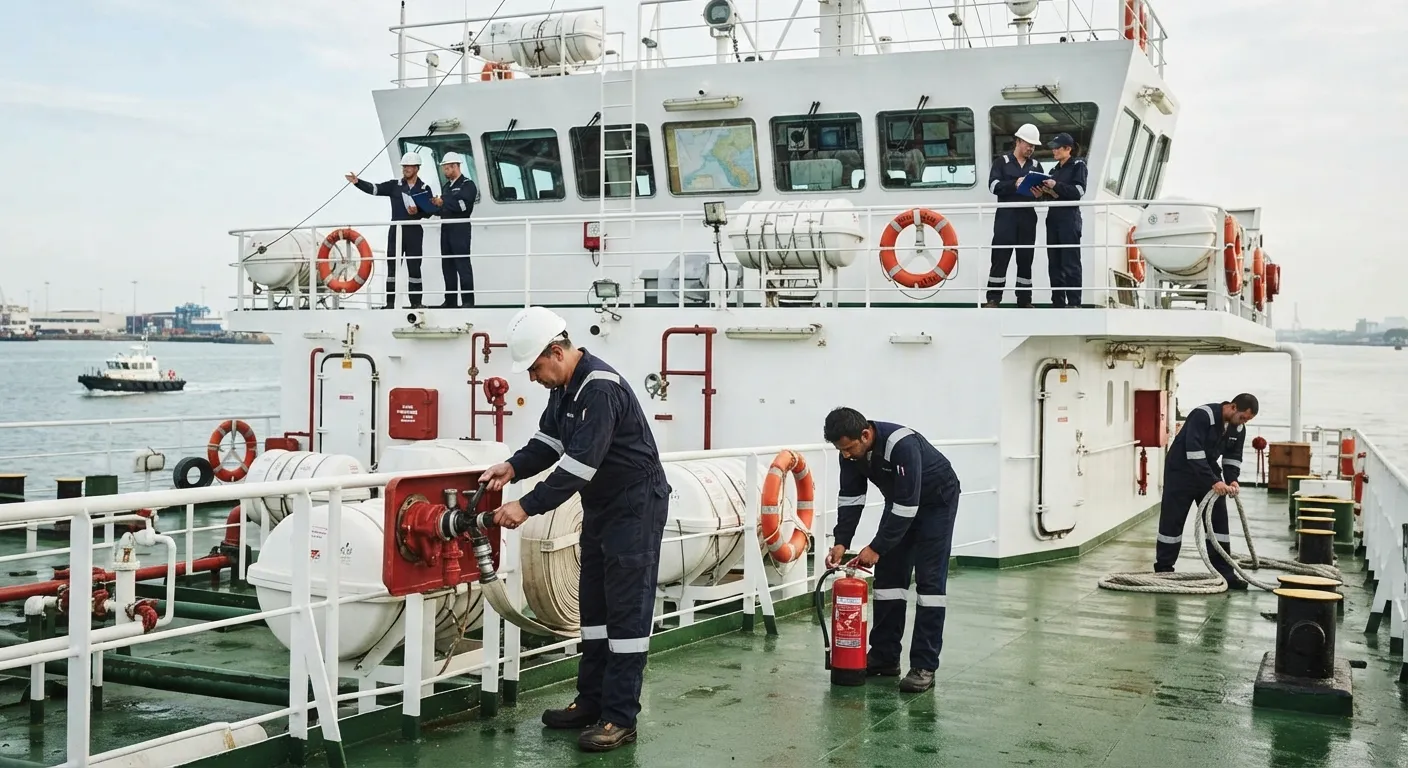
A Port State Control (PSC) inspection can quickly become a serious problem when a ship's equipment, documentation or crew readiness falls short of international requirements. The Paris MoU and Tokyo MoU annual reports for 2025 show the same recurring detention areas year after year: fire safety, life-saving appliances, navigation and maintenance - preventable issues rather than unexpected equipment failures.
Many of these issues can be addressed before the ship reaches port. By identifying common deficiencies, checking critical systems and arranging shore-based servicing in advance, technical superintendents and masters can reduce the risk of delays and detentions.
This guide walks through the main areas PSC officers inspect, including fire safety, life-saving appliances, machinery, pollution prevention, navigation equipment and cargo securing. It also covers the SOLAS amendments in force since 1 January 2026 and the joint Paris and Tokyo MoU inspection campaign on cargo securing that runs until 30 November 2026.
How PSC Officers Select and Inspect Ships
Not every ship faces the same level of inspection. Regional Port State Control regimes select vessels according to their risk profiles, which take into account factors such as ship type and age, flag, recognized organization, company performance and previous deficiencies.
An inspection typically begins with certificates and documentation. The officer then moves on to the ship itself, checking its general condition and the state of its equipment. If the officer finds clear grounds for concern (for example, defective equipment or an expired certificate), the inspection may become more detailed.
The ship's safety management system also matters. Under the ISM Code, deficiencies that indicate a failure of that system can constitute clear grounds for further inspection. Even a series of relatively minor defects can point to a broader problem with maintenance or safety management. In serious cases, the resulting deficiency may lead to detention.
Where PSC Inspections Commonly Find Deficiencies
Fire safety remains a major concern under both the Paris and Tokyo MoU regimes. Other common deficiencies involve structural and electrical systems, life-saving appliances, navigation safety and crew welfare. Documentation, including seafarers' employment agreements, also deserves attention.
According to the Paris MoU and Tokyo MoU annual reports for 2025, fire safety, life-saving appliances, navigation safety and working and living conditions remain the largest deficiency categories, and the Paris MoU detention rate rose year on year.
Ballast water management requires particular attention. Following its 2025 concentrated inspection campaign, the Tokyo MoU reported a marked increase in ballast water deficiencies, linking it to gaps in onboard maintenance.
For practical preparation, crews and technical teams should prioritize critical safety systems, equipment maintenance, crew welfare and documentation. Less frequent deficiencies should not be overlooked, as they can also lead to detention.
Be ready to resolve deficiencies at short notice
Even with thorough preparation, a PSC inspection may uncover a deficiency that must be corrected before the vessel is allowed to leave port. In this situation, having reliable local suppliers available around the clock can make a significant difference.
Diana, maritime expert at RecordsMarine, puts it plainly:
Operators should establish contacts with one or more suppliers in each country who can respond 24/7 and arrange urgent delivery of the equipment or supplies needed to rectify deficiencies. Having these contacts in place before a problem arises helps technical teams act quickly and avoid unnecessary delays.
Fire Safety Systems: Check More Than the Equipment
Fire safety is one of the first areas to review when preparing for PSC. Officers may test individual components during their inspection, so having equipment installed is not enough. It must be maintained, operational and ready to use. Overdue servicing of fixed firefighting systems, fire main isolation valves that cannot operate properly and fire pumps that fail to deliver water on deck have all been identified as potential detention findings.
Start with the fire doors. Check that their self-closing mechanisms work, seals remain intact and doors release correctly from the fire control station. Remove wedges and tie-backs before arrival, and test hold-back magnets and door position indicators.
Next, run both the main and emergency fire pumps. Confirm that they deliver sufficient water pressure at the highest and most remote hydrants. Exercise every fire main isolation valve and replace damaged hoses, couplings and nozzles.
Fixed firefighting systems require the same attention. Check service dates for CO2, foam, water-mist and local application systems. The approved fixed fire-fighting system service provider should verify CO2 cylinder contents and test release alarms and time delays. Test the fire detection panel as well, making sure no faults or isolated loops remain unresolved.
Do not forget portable equipment and supporting safety systems. Verify service dates for portable and wheeled extinguishers, inspect firefighter outfits and breathing apparatus cylinders, and check emergency escape breathing devices.
Finally, test ventilation fire dampers, remote fuel valve closures and remote stops for fans and pumps. These components are easy to overlook during routine checks, but they remain part of the ship's fire safety readiness.
Life-Saving Appliances: Verify Servicing and Approval
Life-saving appliances are another major source of deficiencies, ranking second among the Tokyo MoU's deficiency categories in 2025.
Preparation should begin with lifeboats and rescue boats. Confirm that examinations required under IMO Resolution MSC.402(96) are current. An authorized lifeboat and rescue boat service provider must conduct the required thorough examinations and overhaul on-load release gear. Test the boat engines ahead and astern. Inspect davit winch brakes and limit switches, and verify the renewal dates of the falls.
Then review the rest of the life-saving equipment. Check the service dates of liferafts and hydrostatic release units, including each liferaft painter attachment. Inspect lifejackets, immersion suits, lifebuoys, self-igniting lights and smoke signals. Make sure all pyrotechnics remain within their expiry dates.
There is also a regulatory consideration for newer equipment. Life-saving appliances installed on or after 1 January 2026 must meet the amended LSA Code requirements. The main requirements are:
- Lifejackets must meet revised in-water performance criteria, including turning the wearer to a face-up position.
- A lifeboat or rescue boat hook must not take load unless it is fully reset. It must not release the boat unless the boat is fully waterborne.
- The hook position indicator must not show a reset state unless the hook is properly reset.
- A fully loaded survival craft or rescue boat must not exceed a maximum lowering speed of 1.3 m/s, unless the flag Administration accepts another value. The launching appliance must include a means to hold speed under that limit. A revised formula sets the minimum lowering speed.
- Totally enclosed lifeboats installed on or after 1 January 2029 need ventilation of at least 5 m³/h per person under resolution MSC.535(107). The crew must be able to operate it from inside the boat.
- Resolution MSC.559(108) adds the ventilation system, where fitted, to the annual thorough examination under MSC.402(96).
When ordering replacement equipment, confirm that it carries the appropriate approval rather than assuming that any replacement will satisfy the rules.
Machinery, Structural Integrity and Electrical Systems
SOLAS Chapter II-1 covers the ship's structure, machinery and electrical installations. During an inspection, officers look at both the condition of the equipment and its ability to respond correctly when needed.
Start with the emergency generator. Test it in both automatic and manual modes, and confirm that it takes load and supplies the emergency switchboard and lighting.
Check the main and auxiliary engine shutdowns, oil mist detector and bilge level alarms. Inspect the switchboard insulation monitor and resolve any earth faults.
Steering and communication systems also need attention. Test the main and emergency steering systems, pump changeover and bridge communication. Check watertight doors, including their indicators and local controls.
Other items worth including in the inspection are air pipe heads, ventilator closures and sounding pipe self-closing cocks. Confirm that they operate correctly.
Finally, inspect the ship's structure for visible deterioration. Repair wasted deck plating, corroded hatch cover seals and damaged railings before arrival. Defects in these areas can turn an otherwise routine inspection into a more complicated one.
Pollution Prevention: Make Sure Equipment and Records Match
Pollution prevention inspections involve more than checking whether equipment works. Officers may compare the condition and operation of the equipment against the ship's records. If the system functions correctly but its documentation does not match, the discrepancy can still result in a deficiency.
For the oily water separator, verify that the unit operates properly and that the 15 ppm bilge alarm and automatic stop function as intended. Check that the alarm calibration certificate remains valid and that oil record book entries agree with tank soundings.
Ballast water management systems deserve particular attention following the Tokyo MoU's 2025 campaign. Confirm that the system operates in both ballast and deballast modes. Review sensor calibration, UV lamp operating hours, filter condition and alarm history, and arrange BWTS service if any of these are out of range.
The paperwork must tell the same story as the equipment. Make sure the ballast water record book matches the system log and the approved ballast water management plan.
For MARPOL Annex VI compliance, inspect exhaust gas cleaning system monitoring, fuel sampling points and bunker delivery notes. Also confirm that sewage treatment plant and incinerator certificates are in order and that the ozone-depleting substances record book is up to date.
Navigation and Radio Equipment: Keep Tests and Records Current
Safety of navigation is one of the four largest deficiency categories recorded by the Tokyo MoU. Bridge equipment therefore deserves a dedicated pre-arrival review.
Start with the voyage data recorder (VDR). Confirm that its annual performance test remains valid. Check ECDIS software versions, chart permits and update records.
Test the radar, Automatic Identification System (AIS), bridge navigational watch alarm system, echo sounder and NAVTEX. Make sure compass deviation records are current.
For the Global Maritime Distress and Safety System (GMDSS), verify the GMDSS annual radio survey and any shore-based maintenance agreement. Inspect reserve batteries and their charging arrangements, and ensure that daily and weekly Digital Selective Calling (DSC) tests are recorded.
The Tokyo MoU also conducted a focused inspection campaign on emergency position-indicating radio beacons (EPIRBs) in 2025. Check the expiry dates of EPIRB batteries and release units, and confirm that the annual test record is available.
Cargo Securing: The 2026 Joint Inspection Campaign
From 1 September to 30 November 2026, the Paris MoU and Tokyo MoU are running a joint concentrated inspection campaign on cargo securing arrangements. During routine inspections in this period, officers use a dedicated questionnaire to assess compliance. Each ship receives one campaign inspection under each MoU, and depending on the findings the outcome may range from a recorded deficiency to detention.
The approved Cargo Securing Manual is central to the inspection. Officers will check that the manual is up to date, that crew members understand its contents and that actual cargo-securing practices follow the documented procedures. They may also review stack and tier weight limits, deck and hatch cover loading limits and the Cargo Safe Access Plan.
Before arrival, inspect both fixed and portable lashing equipment. This includes twistlocks, lashing rods, turnbuckles, D-rings and deck sockets. Replace damaged items and record every replacement. Check spare lashing equipment as well. The available stock must meet the requirements specified in the manual.
SOLAS Requirements That Entered into Force on 1 January 2026
Several SOLAS amendments took effect on 1 January 2026. Some apply to existing ships at their next survey, which means inspectors can check compliance once the relevant survey date has passed.
Lifting appliances and anchor handling winches
New SOLAS regulation II-1/3-13 covers lifting appliances and anchor handling winches. The requirements extend to common shipboard equipment, including stores cranes and engine room cranes. For appliances installed before 2026, a load test and thorough examination must be completed by the first renewal survey on or after 1 January 2026.
Ships must also maintain a register of lifting appliances and a manufacturer's maintenance manual for each appliance. However, valid certificates issued under another international instrument before 2026 remain acceptable.
Fire protection and firefighting foam
The 2026 amendments also introduce fire protection changes. Firefighting foams containing PFOS are prohibited. Existing ships must remove these foams by their first survey after 1 January 2026. The new rules also require confirmation of fuel oil flashpoint. In addition, cargo ships built on or after 1 January 2026 must have fire detection in control stations and cargo control rooms.
Ro-ro passenger ship requirements
Ro-ro passenger ships face new requirements for fire detection, containment and suppression in vehicle spaces. Existing ro-ro passenger ships must comply with these requirements by their first survey on or after 1 January 2028. Technical teams should account for this deadline when planning upgrades and surveys.
Certificates, Records and Crew Familiarity
A PSC inspection often begins at the desk, not in the engine room. Missing documentation, expired certificates or missed survey windows can provide clear grounds for concern before an officer tests any equipment. Review the validity and annual endorsements of all statutory and class certificates. Confirm that shore-service certificates for liferafts, fixed firefighting systems, the VDR and calibrated alarms are available on board. The planned maintenance system should also reflect the ship's actual condition. Check that completed jobs are recorded and that any deferred work is explained.
Crew readiness is equally important. Officers may ask crew members to operate equipment or explain how a procedure works. A system can be in good condition, but unfamiliarity with its operation can still raise questions about the ship's safety preparedness. Run fire drills and abandon-ship drills before arrival, and make sure they are logged. Brief engineers on emergency generator starting procedures, fire pump operation and oily water separator use.
Finally, review seafarers' employment agreements and rest-hour records. These fall under the MLC, and related deficiencies feature in the Paris MoU's inspection data.
Pre-Arrival PSC Technical Service Checklist
Use this checklist before the ship enters a PSC region. If the crew cannot resolve an issue on board, arrange shore-based service before the port call wherever possible.
- Fire doors close and latch correctly, with no wedges or tie-backs.
- Main and emergency fire pumps deliver sufficient pressure at remote hydrants.
- Fire main isolation valves operate freely.
- Fixed firefighting systems have valid service dates.
- The fire detection panel has no unresolved faults or isolated loops.
- Portable extinguishers, breathing apparatus and emergency escape breathing devices are serviced.
- Lifeboat, rescue boat and release gear examinations are current.
- Liferafts and hydrostatic release units are within their service dates.
- The emergency generator starts and takes load.
- Steering gear changeover and emergency steering have been tested.
- The oily water separator and 15 ppm alarm work, and the calibration certificate is valid.
- The ballast water management system operates correctly, and its records agree.
- The VDR annual performance test and GMDSS radio survey are valid.
- EPIRB batteries and release units are within their expiry dates.
- Lashing gear has been inspected, and the Cargo Securing Manual is current.
- Lifting appliances are registered, marked and certified.
- PFOS-based firefighting foam has been removed where the applicable survey deadline requires it.
- Certificates, endorsements and shore-service reports are available on board.
- Required drills have been completed and recorded.
Booking Technical Service Before the Port Call
Many PSC preparation tasks require an approved shore-based service provider. Crew checks are essential, but they cannot replace the required servicing and examinations for equipment such as liferafts, fixed firefighting systems, lifeboat release gear, VDRs and calibrated alarms.
Arranging these services before the ship reaches port gives the technical team more time to address deficiencies and obtain the necessary documentation.
RecordsMarine helps ship operators find marine service companies by category and port. Use it to shortlist and contact providers for PSC preparation, from fire system servicing to radio surveys, ahead of the vessel's next call.