Ship Catering vs. Self-Supply of Provisions and Bonded Stores: Pros and Cons

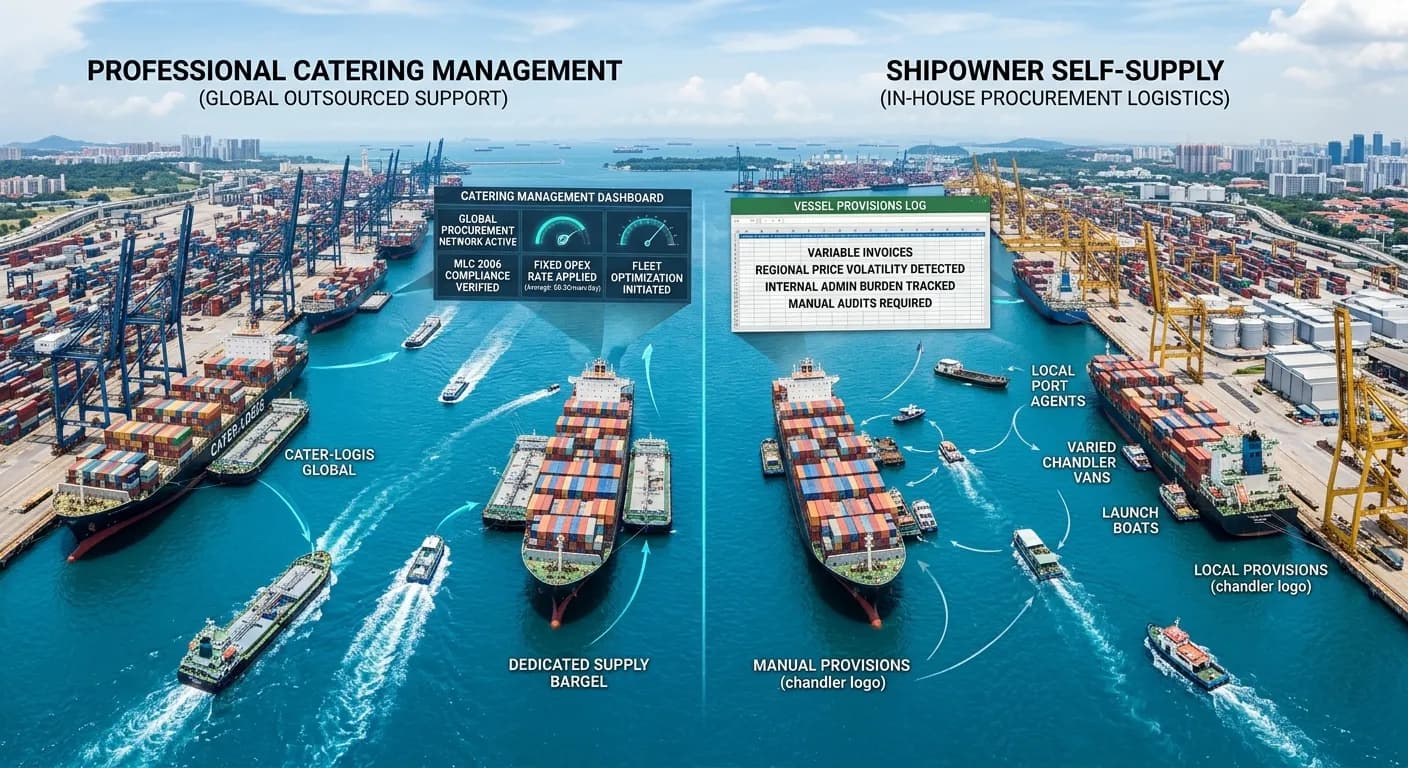
Shipowners have two main options for supplying their crews with provisions and bonded stores. They can outsource the process to a specialized ship catering company or manage supplies themselves, ordering provisions from a ship chandler at each port of call.
Bonded stores are duty-free goods intended for the crew, such as cigarettes, alcohol, and soft drinks. They are kept in a sealed store and recorded separately from provisions.
For fleet managers and procurement managers, choosing between these models involves more than comparing prices. Each approach affects budget control, supply availability, compliance, and the workload of the shore-based team.
This article compares ship catering and self-supply across six key criteria, examines the hybrid model, and explains how to choose the right approach based on fleet type and trading patterns.
How Ship Catering Works
With ship catering, a specialized company takes responsibility for feeding the crew. The shipowner signs a contract covering either the entire fleet or individual vessels.
The scope of the contract typically includes:
- Menu planning based on crew nationality and trading area.
- Nutrition standards per person per day.
- Selection, training, and certification of ship's cooks.
- Delivery of provisions to ports within the caterer's network.
- Onboard stock control and hygiene procedures.
- Reports to the office covering consumption, stock levels, and food safety.
The services offered by established providers illustrate how this model works in practice. Some companies include cook selection, onboard stock control, and hygiene procedures in its offering. Other companies coordinate provisions at a fixed rate per crew member per day. Their reporting covers consumption, galley performance, stock levels, and food safety.
What MLC 2006 Requires
Ship catering contracts are designed around Regulation 3.2 and Standard A3.2 of the Maritime Labour Convention, 2006.
The main requirements are:
- Seafarers must receive food free of charge.
- Ship's cooks must be trained and qualified.
- Cookery training must cover practical cookery, hygiene, food storage, stock control, environmental protection, and catering health and safety.
- No seafarer under 18 may work as a ship's cook.
- The master, or a person acting under the master's authority, must carry out frequent, documented inspections of food stores and the galley.
Ships with a prescribed manning level of fewer than ten may be exempt from the requirement to carry a fully qualified cook. However, anyone handling food must still receive training in hygiene and food storage.
These requirements apply regardless of the supply model. Hiring a catering company does not remove the vessel's compliance obligations. Instead, the provider takes over much of the work involved in meeting them.
How catering rates are calculated
Ship catering is generally priced at a fixed rate per person per day. The rate covers provisions and the caterer's services, allowing the office to plan the crew feeding budget in advance. Published benchmarks provide a useful starting point for cost comparisons. According to Esenyel Partners, daily catering costs on dry bulk carriers and tankers range from USD 8 to USD 20 per person.
Actual rates depend on the provider, trading area, and contract terms. To make a meaningful comparison, request quotations from several catering companies for the same route and service scope.
Checking the caterer's port coverage
A catering company can deliver provisions only to ports where it has suppliers or an established supply network. This makes network coverage an important factor when selecting a provider. Large catering companies publish information about their reach.
Before signing a contract, compare the provider's port list with the actual ports of call for your vessels. A large network is useful only if it covers the routes your fleet operates on.
How Self-Supply Works
Under the self-supply model, the vessel purchases provisions and bonded stores directly, without a catering company acting as an intermediary.
The process usually follows these steps:
- The cook checks existing stock and prepares a requisition.
- The master approves the requisition and sends it to the agent or ship chandler at the port of call.
- The ship chandler prepares and sends a quotation.
- The master or the shore-based office approves the quotation.
- The ship chandler delivers the provisions on board during the port call.
- The vessel receives the goods and forwards the checked and stamped delivery notes to the office. The office checks the invoice sent by the supplier and pays it.
Under self-supply, the company usually sets a daily food allowance per person. The master is responsible for keeping consumption within that budget. The company can establish menus and nutrition standards centrally, or the cook can plan meals based on experience.
The main variable is the price of provisions. According to ShipUniverse, provisioning costs can vary by 20–40% between ports, depending on local economies, supply chains, and demand. As a result, a vessel using self-supply pays the local market price each time it replenishes its stores. Costs can therefore change significantly from one port to another.
Stock levels are recorded on board, but the office may see only the invoice totals rather than actual consumption by individual item. The master remains responsible for food store inspections under the MLC, regardless of the supply model.
The Two Models Compared on Six Criteria
Both ship catering and self-supply can meet a vessel's provisioning needs, but they differ in how much control and responsibility remain with the shipowner.
Swipe horizontally to view all columns
Criterion | Catering company | Self-supply |
Supply ports | Limited to ports within the caterer's network | Any port with a ship chandler |
Timing | Fixed schedule that the vessel must accommodate | Ordered to suit the vessel's schedule |
Menus, standards, and cook training | Included in the service | Managed in-house or not provided |
Stock records, write-offs, and reporting | Managed by the caterer | Not maintained or recorded manually on board |
Budget control | Fixed rate per person per day | Depends on port prices and the master's discipline |
Office workload | Low | High |
Here's what these differences mean in day-to-day operations.
Swipe horizontally to view all columns
Aspect | Ship catering | Self-supply |
|---|---|---|
Supply ports | Delivery only to ports within the catering company's network. | Provisions can be ordered from a ship chandler at any port where a suitable supplier is available. |
Timing | Deliveries follow agreed schedules, so vessels plan provisioning around them. | Orders can be placed at the next port of call, subject to local supplier availability. |
Menus, standards, and cook training | Included in the contract: menu planning, nutrition standards, and cook training. | The company develops these procedures itself or operates without a formal system. |
Stock records, write-offs, and reporting | The provider maintains records for each vessel and submits reports to the office. | Records may be kept manually on board or not kept at all. |
Budget control | A fixed rate that the company can use for budgeting. | Spending depends on local prices, purchasing decisions, and the master's ability to manage the allowance. |
Office workload | The office manages a single contract and reviews the provider's reports. | Staff handle requisitions and invoices for every vessel and port, increasing the administrative workload. |
When port restrictions become a problem
A catering company's network may cover the main ports on regular routes, but less predictable trading patterns can make this arrangement difficult.
Three situations are particularly challenging:
- Tramp shipping. The vessel follows available cargo rather than a fixed route. Its next port of call may fall outside the caterer's network.
- Voyage changes. A charterer changes the discharge port, making the planned provisioning delivery impossible.
- Remote ports. Smaller ports may not have a catering company's supplier. The vessel may need to carry enough stock for several voyages ahead.
In these situations, the vessel may have to purchase provisions from a local ship chandler outside the catering contract. This creates an additional expense and means the purchase falls outside the caterer's stock records and reporting.
Running short of food is also a compliance issue, not just a budgeting problem. The Paris MoU detention guidance identifies insufficient food for the voyage to the next port as grounds for detention.
Bonded stores: customs rules apply to both models
Whether provisions and bonded stores are purchased directly or supplied through a catering company, the relevant customs rules still apply. Requirements depend on the jurisdiction and port.
Canada provides one example. Under the Ships' Stores Regulations, alcohol, tobacco, and goods intended for sale must remain under lock or seal while the vessel is in port. The master is responsible for ensuring compliance.
Crew allowances are also restricted. For example, the Canadian ship stores declaration specifies the following per-person limits on arrival:
- 200 cigarettes.
- 50 cigars.
- 0.9 kg of tobacco.
- 1.1 litres of liquor.
Any quantities exceeding the permitted limits must be secured. Unreported goods may be forfeited.
Under self-supply, the master must track the applicable requirements at each port. A catering company or bonded stores supplier can take over the relevant declarations and stock records, depending on the services agreed.
The cost of missing stock records
Without systematic stock records, a company cannot accurately track actual consumption. This can lead to three common problems.
- Overspending. Requisitions include a safety margin, and the master orders more than the vessel needs before its next port call.
- Write-offs. Perishable goods spoil because too much stock has been purchased. The losses may go unrecorded or be recorded without an explanation.
- Disputes with the crew. Crew members complain about food quality or variety. Without documented menus and standards, the company has no clear basis for demonstrating that the food meets requirements.
Food quality is not merely a subjective concern. Food and catering are also areas of concern during inspections. This is why it is important to manage quality, stock levels, and provisioning costs systematically, regardless of the supply model.
The Hybrid Model: Combining Catering Management with Local Supply
A hybrid model combines elements of ship catering and self-supply. The catering company provides the management framework, while the vessel purchases provisions from local ship chandlers.
In this arrangement, the caterer typically provides:
- Menus and nutrition standards.
- Cook training.
- Requisition and stock record templates or software.
- Reviews of reports submitted by the vessel.
The vessel and the shore-based office remain responsible for:
- Selecting a ship chandler at the port of call.
- Preparing requisitions and receiving provisions.
- Paying supplier invoices.
The main advantage of the hybrid model is that it removes the restriction to a catering company's delivery network while allowing the company to maintain food standards and stock records.
The trade-off is administrative workload. The office must work directly with ship chandlers and process orders and invoices, so the workload is higher than with full catering but lower than with fully independent self-supply.
This approach is particularly suitable for tramp vessels and ships operating on unpredictable routes when the company still needs to control consumption and maintain consistent food standards.
How to Choose the Right Model
The choice between ship catering, self-supply, and a hybrid arrangement depends on three main factors: vessel routes, crew size, and the resources available in the shore-based office.
When ship catering makes sense
Ship catering is a suitable option if:
- Vessels operate on regular routes.
- Most ports of call are covered by the catering company's network.
- The office does not have a specialist responsible for provisioning.
- The company needs a predictable crew feeding budget.
When self-supply makes sense
Self-supply may be a better fit if:
- Vessels operate in tramp trade.
- Routes change frequently.
- Vessels call at ports outside major catering networks.
- The office has an employee responsible for controlling requisitions and invoices.
When to consider the hybrid model
A hybrid arrangement is worth considering if:
- Vessel routes are unpredictable.
- The company needs consistent food standards and reliable stock records.
- The office is prepared to work directly with ship chandlers.
Crew size also matters for compliance and for the value a catering provider can offer. Under MLC Standard A3.2, ships with a prescribed manning level of fewer than ten may not be required to carry a fully qualified cook.
On these vessels, the training and menu planning provided by a catering company may offer less additional value. On vessels with larger crews, a qualified cook is mandatory, and a catering company can help by supplying and training one.
Where to Find Suppliers
Once the company has selected a provisioning model, the next step is to find suitable ship chandler in the ports where its vessels operate.
Explore Records Marine to find catering companies, provisions suppliers, and ship chandlers in the ports your vessels need. Comparing available suppliers and their service coverage can help your team identify suitable partners for your fleet's provisioning requirements.