The Turkish Straits: Supplies and Services in the Bosphorus and Dardanelles

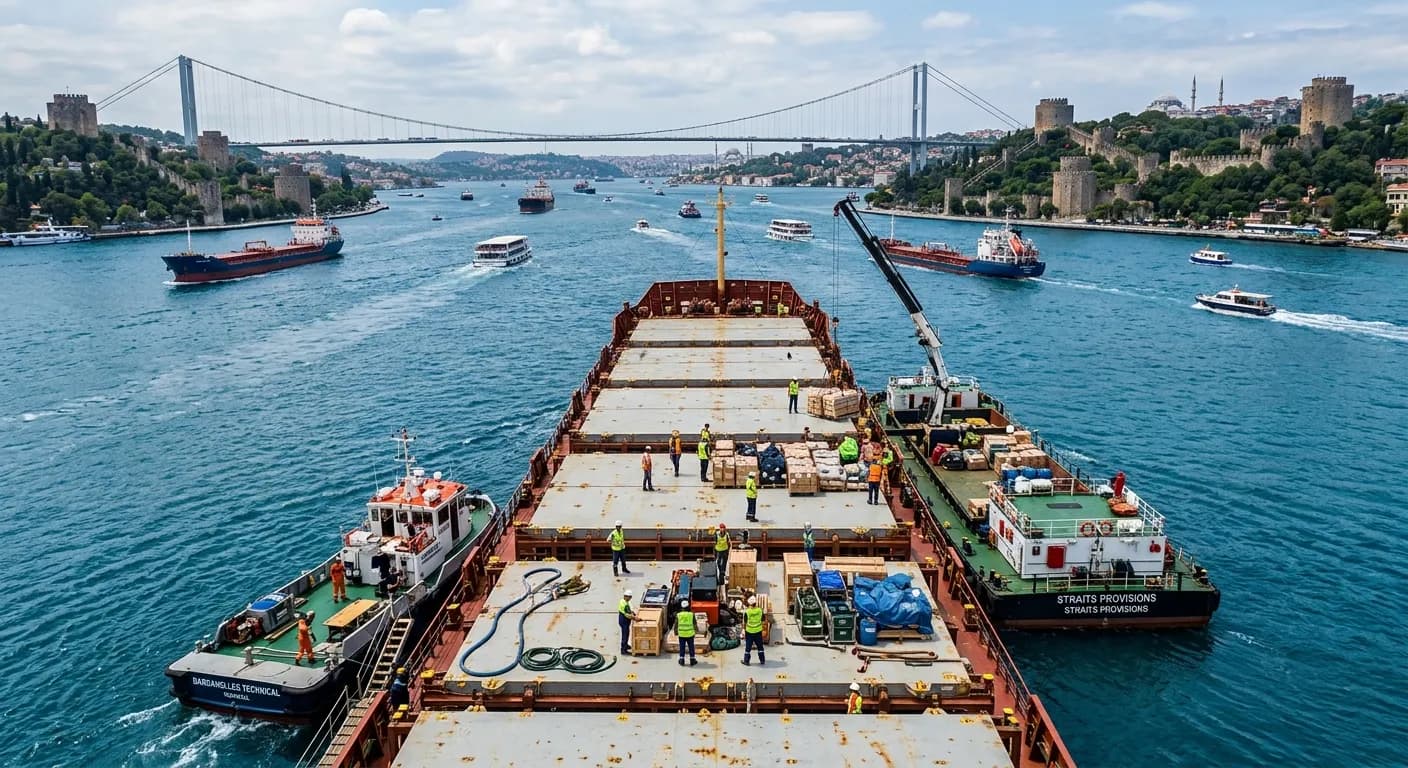
Turkish Straits transit can be a practical opportunity to take on stores, spare parts, and services. The key is to plan these activities around Turkish traffic rules, transit requirements, and the vessel's schedule.
Every merchant vessel trading between the Black Sea and the Mediterranean passes through the Bosphorus and the Dardanelles. Many vessels wait at anchor for pilots, suitable weather, or traffic clearance. That waiting time can be used to take on supplies, provided the delivery is planned correctly.
The straits have their own legal regime, traffic rules, and customs procedures. Weather and traffic restrictions can also make the schedule less predictable. For operators, this means that supply planning has to take the transit regime into account from the start.
This article explains where supplies can be delivered, what can be done without stopping, and how to plan around customs, weather, and supplier selection.
The Transit Regime: What Operators Need to Know
The Turkish Straits are not a single waterway. The system consists of three parts: the Istanbul Strait (Bosphorus), the Sea of Marmara, and the Çanakkale Strait (Dardanelles).
The Bosphorus is 17 NM long, the Sea of Marmara is 110 NM, and the Dardanelles is 37 NM. Together, they form a 164 NM waterway between the Black Sea and the Mediterranean.
This entire route is subject to Turkish traffic control and transit rules. The legal framework starts with the 1936 Montreux Convention, which gives merchant vessels freedom of transit and navigation in peacetime, regardless of flag or cargo. Turkey also applies national traffic rules to the straits.
The first set of Turkish traffic rules came into force in 1994 and was revised in 1998. The current Turkish Straits Maritime Traffic Regulation was published in the Official Gazette on 15 August 2019 (No. 30859).
Traffic control and entry times
Turkish Straits Vessel Traffic Services (TSVTS) monitor the entire area. The Directorate General of Coastal Safety operates the system through two VTS centres, located at İstinye in Istanbul and Akbaş in Çanakkale.
TSVTS uses the vessel's Sailing Plan reports (SP1 and SP2) to set entry times. If these reports are submitted late or contain incorrect information, the vessel's entry slot can be delayed. A delayed slot can then affect any supply delivery planned around the vessel's arrival.
This is why supply planning needs to be coordinated with the vessel's transit schedule rather than arranged separately.
Pilotage
Pilotage for the transit is strongly recommended but is not compulsory for most vessels. The same department also provides pilots for anchoring, heaving up anchor, and berthing in the straits.
The agent confirms which manoeuvres require a pilot for the specific vessel. This should be established before arranging any operation that depends on the vessel anchoring, berthing, or moving within the straits.
Restrictions for large vessels and dangerous cargo
Vessel size and cargo can trigger additional restrictions. Some vessels may be allowed to transit only during daylight hours. Others may be subject to one-way traffic, which suspends traffic in the opposite direction.
Tankers over 300 m LOA face additional restrictions. One-way traffic periods can create queues at both ends of the Bosphorus, which can affect the timing of planned deliveries and services.
Anchoring for bunkers and stores
Anchoring does not necessarily mean that a vessel has stopped its transit for legal purposes. A vessel that anchors only to take on bunkers or stores remains in transit.
The Turkish Court of Appeal confirmed this position after the 2012 Turkish Commercial Code came into force. The court held that anchoring to replenish bunkers did not break the transit or give Turkish courts jurisdiction to arrest the vessel.
Operators should still confirm the current position with their agent and P&I correspondent before planning an operation that requires the vessel to anchor.
Where to Take Supplies: Istanbul and Çanakkale Anchorages
The main options for where to take supplies are the following:
Swipe horizontally to view all columns
Location | Strait end | Best suited for |
Istanbul South Anchorage (Ahırkapı area) | Bosphorus, Marmara side | Full range of stores, spares, crew changes, and technical attendance |
Büyükdere | Bosphorus, Black Sea side | Southbound vessels; vessels held inside the strait |
Çanakkale anchorages | Dardanelles, both ends | Vessels transiting the Dardanelles only; urgent top-ups |
The Istanbul South Anchorage is the main supply point for transiting vessels. Most of the local ship supply industry operates from the Zeytinburnu side of the city.
Istanbul South Anchorage
The Istanbul South Anchorage, including the Ahırkapı area, is located at the Marmara entrance to the Bosphorus, off Istanbul’s old city. It is the main anchorage used by vessels waiting to transit the Bosphorus or arranging supplies and services.
Since 5 January 2023, the authorities have designated different parts of the anchorage for specific vessel types and activities:
Swipe horizontally to view all columns
Area | Assigned use under the 2023 notice |
A | Vessels waiting to berth at shore facilities |
B | Vessels that have left shore facilities and will stay for a long period |
C | Vessels carrying dangerous goods, nuclear-powered warships, and vessels carrying out gas-freeing |
F | Vessels carrying dangerous goods that will transit the Bosphorus |
G | Quarantine area |
Vessels can remain in areas A, B, and C for up to 72 hours. If a vessel needs to stay longer, it may be moved to another anchorage in the Sea of Marmara. Operators should take this limit into account when planning repairs, deliveries, or other work that requires the vessel to remain at anchor.
Anchoring in the designated area is also important for safety. In May 2025, the General Directorate of Maritime Affairs warned vessels against anchoring outside the assigned zones because subsea cables and pipelines run through the area.
If a vessel anchors outside its designated zone, the port authority can assign an escort tug. The vessel operator is responsible for the related costs, including any underwater hull inspection. The agent should therefore confirm the assigned anchorage with the master before the vessel drops anchor.
Zeytinburnu and Zeyport
Zeyport is the main shore base for supply and service boats working with vessels at the Istanbul South Anchorage. Since 2005, it has been the designated departure point for boats serving transiting vessels and vessels waiting at the anchorage.
Zeyport also operates as a sea border crossing and has an immigration office. Its facilities include bonded and cold storage, a duty-free point, and facilities for crew changes.
Diana, our maritime supply specialist, says the Istanbul anchorage is generally the most convenient and cost-effective option for taking on supplies.
Supply launches depart from Zeyport and can usually reach the vessel within one to four hours. Depending on the delivery, launch costs are comparatively moderate, typically around USD 150–400
She adds that supplies can also be delivered while the vessel is drifting on the Marmara Sea side before entering the Bosphorus, which can be more practical than arranging a delivery inside the strait itself.
For operators, this means that many supply operations can be coordinated through Zeyport, including provisions, bonded stores, spare parts, and crew changes. The port states that around 80% of ship supply transactions in the area pass through its facilities.
Büyükdere
Büyükdere is located inside the Bosphorus, closer to the Black Sea entrance. It can be a practical delivery point for southbound vessels and vessels that are waiting inside the strait.
Supply lead times and launch costs may differ from those at the Istanbul South Anchorage, so operators should compare the two options when planning a delivery.
Çanakkale
There are anchorages at both entrances to the Dardanelles. Çanakkale has a smaller supply market than Istanbul, so the availability of stores, spare parts, and service boats can be more limited.
For vessels that have missed the Istanbul supply window or are transiting only the Dardanelles, Çanakkale can provide an alternative delivery point.
Diana says Çanakkale is mainly used for urgent or critical supplies and spare parts, particularly when the items could affect the vessel's ability to transit the straits.
It is not usually the most convenient option for a large supply order because the local market is limited. Much of the supply still has to come from Istanbul, which adds trucking costs of around USD 700–800 per truck, as well as higher launch costs.
Advance notice is recommended, particularly for larger or less common orders.
Underway Delivery Versus Anchoring
Not every supply delivery requires the vessel to anchor. Small and light items can sometimes be delivered by launch while the vessel is underway, provided the delivery has been arranged in advance, and the conditions are suitable.
Diana notes that underway delivery in the Marmara Sea is generally reserved for exceptional and urgent cases.
It can create a risk of losing the vessel's position in the transit queue, so it is not normally the preferred option. Dangerous goods, including chemicals and paint, should not be delivered while the vessel is underway.
Typical underway deliveries include ship's mail and documents, charts and publications, small spare parts and consumables, and limited quantities of provisions or bonded stores. Items such as filters, gaskets, and test kits can also be delivered when they are needed immediately and can be handled safely by the crew.
Larger deliveries and operations that require stable access to the vessel usually require anchoring. These include:
- Heavy or bulky spare parts that require the vessel's crane
- Large quantities of provisions or stores
- Crew changes, which require immigration clearance and a safe transfer
- Service engineer attendance and repairs that require machinery to be stopped
- Surveys, inspections, and class attendance
Whether a delivery can be carried out underway depends on the vessel's speed, sea conditions, traffic, and the size and weight of the items being delivered. The agent and supplier should agree on the delivery method and location before the vessel enters the strait.
Practical Limits for Underway Delivery
Underway delivery is subject to practical limits. A launch can come alongside only when the vessel's speed, sea conditions, current, and traffic allow it to be done safely. The Bosphorus has strong currents and heavy local traffic, with ferries and other local craft making more than 2,500 crossings a day.
As a result, launch operations inside the strait are limited. Most underway deliveries take place near the approaches or close to the anchorage areas, where the conditions are easier to manage.
The master, agent, and chandler agree on the delivery time and rendezvous position. This timing also has to fit the vessel's TSVTS transit slot. If the slot changes, the launch operation may need to be rescheduled.
A missed slot can mean that the vessel has to anchor for the delivery or that the order has to be moved to the next port. For urgent items, operators should therefore agree on a fallback arrangement before the vessel enters the strait.
Customs and Administration
For transit deliveries, customs procedures can have as much impact on the schedule as the physical delivery itself. Spare parts, bonded stores, crew changes, and service engineer attendance each require different arrangements, so the paperwork should be prepared before the vessel reaches the delivery point.
Customs and administration
Customs procedures can affect the timing of transit supplies. Spare parts brought from abroad must be properly documented and cleared before delivery, while bonded stores remain under customs control. Zeyport provides facilities for bonded storage and related deliveries.
To avoid delays, operators should coordinate the required paperwork with the agent and supplier well in advance and confirm customs requirements before the shipment reaches Turkey.
Crew changes require additional immigration procedures. Zeyport has operated as a sea border crossing with an immigration office since 2016, and crew changes at the Istanbul anchorage are handled through this facility.
Joining and leaving crew members need valid travel documents and, where applicable, visas. The agent coordinates immigration clearance, launch transfers, and any required hotel or airport transport. Operators should allow enough time for document checks before the crew launch is scheduled.
Service engineer attendance
Service engineers boarding a transiting vessel also need to be declared in advance. Foreign engineers may require valid travel documents and, depending on the work, a work or business permit.
Tools and test equipment brought from abroad may also require customs documentation. Using a local Turkish service company can simplify the process because the equipment is already within the local customs system.
Before arranging any delivery or service, the operator should confirm the customs cut-off time, whether clearance is available on weekends or public holidays, and any additional charges that may apply. It is also important to check how long the vessel is expected to remain at anchor and whether this fits within the applicable 72-hour limit.
Finally, agree in advance who will hold the goods and what storage costs will apply if the vessel misses its delivery window.
Weather and Seasonal Factors
Weather and traffic conditions can change a Turkish Straits transit with little notice. Fog, strong winds, and traffic suspensions can delay a transit slot by several hours or more. Supply deliveries should therefore be planned around a delivery window rather than a fixed time, with enough flexibility to accommodate a delayed transit.
The vessel's commercial schedule can make this flexibility particularly important. Diana explains that a vessel with a fixed voyage schedule may not be able to remain at anchor for an extended period because it needs to meet its laycan at the loading or discharge port.
For this reason, supplies should ideally be ready and already stored at Zeyport with customs formalities completed. The launch can then be loaded and dispatched as soon as the vessel reaches the Istanbul anchorage.
Dense fog is one of the most common causes of traffic suspensions in the Bosphorus. It occurs most often in winter but can also affect the strait in spring and autumn. Suspensions can last several hours, and traffic may resume in one direction before the other. A vessel waiting for the opposite direction may therefore face a longer delay.
Strong winds can also suspend pilotage in the Bosphorus. Even when the strait remains open, launch operations at the anchorage may have to stop if the conditions are unsafe. A vessel may therefore be able to continue its transit while a planned supply delivery cannot take place.
The Bosphorus also has strong currents, sharp bends, and heavy local traffic. These conditions can limit when a launch can safely come alongside, particularly near the strait entrances. Ferries and other local vessels add to the traffic density, making precise timing important for any delivery operation.
For supply planning, these conditions mean that operators should:
- Schedule deliveries around the expected transit window rather than a fixed hour.
- Keep perishable provisions and urgent spare parts at the warehouse until the vessel's transit slot is confirmed.
- Agree in advance what will happen to the goods if the vessel transits without stopping.
- Allow additional time for weather-related delays, particularly during the winter months.
The fog and traffic suspension examples in this section are based on GAC hot port news bulletins. They illustrate the types of delays that can occur and are not intended as a complete record of Turkish Straits closures.
Choosing an Agent and Ship Chandler in Istanbul
The agent coordinates the vessel's movements and local formalities, while the ship chandler handles the goods and delivery. Both should have experience with Turkish Straits transits, as timing and local procedures can affect the total cost and whether a delivery takes place as planned.
Istanbul has a large and competitive ship supply market, with many chandlers operating around Zeytinburnu. Operators should therefore compare suppliers on their ability to manage the complete delivery, not only on the unit price.
What to check in a transit agent
A suitable agent should have:
- Regular experience with Turkish Straits transits, not only conventional port calls
- Working contacts with TSVTS, pilots, and the port authority
- A 24/7 operations desk with an English-speaking duty officer
- Clear updates on transit slot changes, weather suspensions, and anchorage assignments
- A transparent proforma disbursement account with all expected fees itemised
Diana also recommends reviewing the supplier's offer beyond the headline price.
Pay attention to all remarks in the quotation and to the delivery times. Almost everything may be in stock except for a few items, and those can turn out to be the most important ones.
She also recommends collecting the vessel's complete requirements from the crew as early as possible so that suppliers can be compared before the delivery window becomes tight.
When comparing offers, operators should include customs, trucking, packaging, and other associated costs. In some cases, accepting a slightly higher unit price from one supplier can reduce the overall cost if several orders can be consolidated and customs and delivery charges are paid only once.
The agent should also be able to explain what happens if the vessel's transit slot changes or the planned anchorage delivery is no longer possible.
What to check in a ship chandler
For the chandler, check:
- Access to suitable supply launches operating from Zeyport
- Bonded and cold storage for the types of goods being ordered
- Sufficient stock for the required categories, quoted against IMPA codes where applicable
- Experience handling spares in transit and completing customs procedures
- Relevant industry memberships, such as ISSA, and applicable quality certificates
- References from operators working with similar vessels or trades
For urgent spare parts, it is also worth confirming who will handle the customs process and who is responsible for the shipment until it reaches the vessel.
Greg, our maritime expert, says Istanbul has a large market for both ship chandlers and service providers.
There are many vendors in the area, so operators can usually find options for different budgets and requirements.
He notes that ship chandlers generally offer competitive prices, reasonable quality, and a good stock of provisions and spare parts. Istanbul also has authorised service representatives for many major equipment manufacturers, so specialist support does not always have to be arranged from abroad.
Service support is another option. Istanbul has a wide range of workshops and riding teams that can attend vessels. Greg recommends checking the quality of the service provider carefully, as the standard of workshop work can vary. For vessels requiring work during a voyage, operators can also find service personnel with seafarers' passports who are able to travel with the vessel.
Common pricing traps
The lowest unit price does not always result in the lowest total cost. Operators should check for:
- High launch, delivery, or urgent-order surcharges added to low unit prices
- Separate customs handling or storage charges
- Weekend, night, or public holiday surcharges
- Unfavourable currency conversion between the quotation and final invoice
- Brand or grade substitutions made without prior approval
An all-in quotation should show the main costs before the order is confirmed.
Common timing traps
Timing problems can delay a delivery or make it impossible to complete at the planned location. Common examples include:
- Promising a delivery before the vessel's transit slot is confirmed
- No fallback plan if the vessel transits without stopping
- Spare parts arriving at Istanbul airport after the customs cut-off
- One launch being scheduled for several vessels and creating waiting time
These risks are particularly important for urgent spare parts and perishable provisions.
Practical steps
Before placing an order, ask for an all-in quotation covering the goods, launch hire, customs handling, storage, and applicable surcharges. Confirm customs and delivery cut-off times in writing.
Also agree in advance who will store the goods and what charges will apply if the vessel misses the delivery window. Where possible, use one local coordinator for agency and supply operations so that changes to the vessel's schedule can be communicated to everyone involved.
Conclusion and Planning Checklist
A Turkish Straits transit can replace a separate port call for stores, spare parts, and services. It works when the order, paperwork, and transit slot are planned together.
A local team that works with the straits every day can also reduce the risk of a missed delivery.
Before arranging a transit supply, check the following:
- Agent appointed and Sailing Plan reports scheduled
- Delivery point selected: underway, Istanbul South Anchorage, Büyükdere, or Çanakkale
- Order placed and cut-off times confirmed in writing
- Spares-in-transit documents sent to the agent before dispatch
- Bonded and provision orders combined on one launch
- Crew change documents and immigration requirements checked
- Service engineer attendance declared and required permits confirmed
- Weather buffer and the 72-hour anchorage limit included in the plan
- Fallback arrangement agreed if the vessel does not stop
- All-in quote received, including launch, customs, and surcharges
Find Maritime Suppliers and Services in the Turkish Straits
Records Marine connects ship managers and vessel operators with suppliers, ship chandlers, workshops, and maritime service providers across Turkey.
Suppliers can create a free company profile to showcase their services and reach potential clients. Ship managers and operators can explore suppliers, post RFQs, receive offers, and compare options for provisions, spare parts, technical services, and other vessel needs.