Malacca and Singapore Straits: Planning Bunkers, Supplies and OPL Repairs

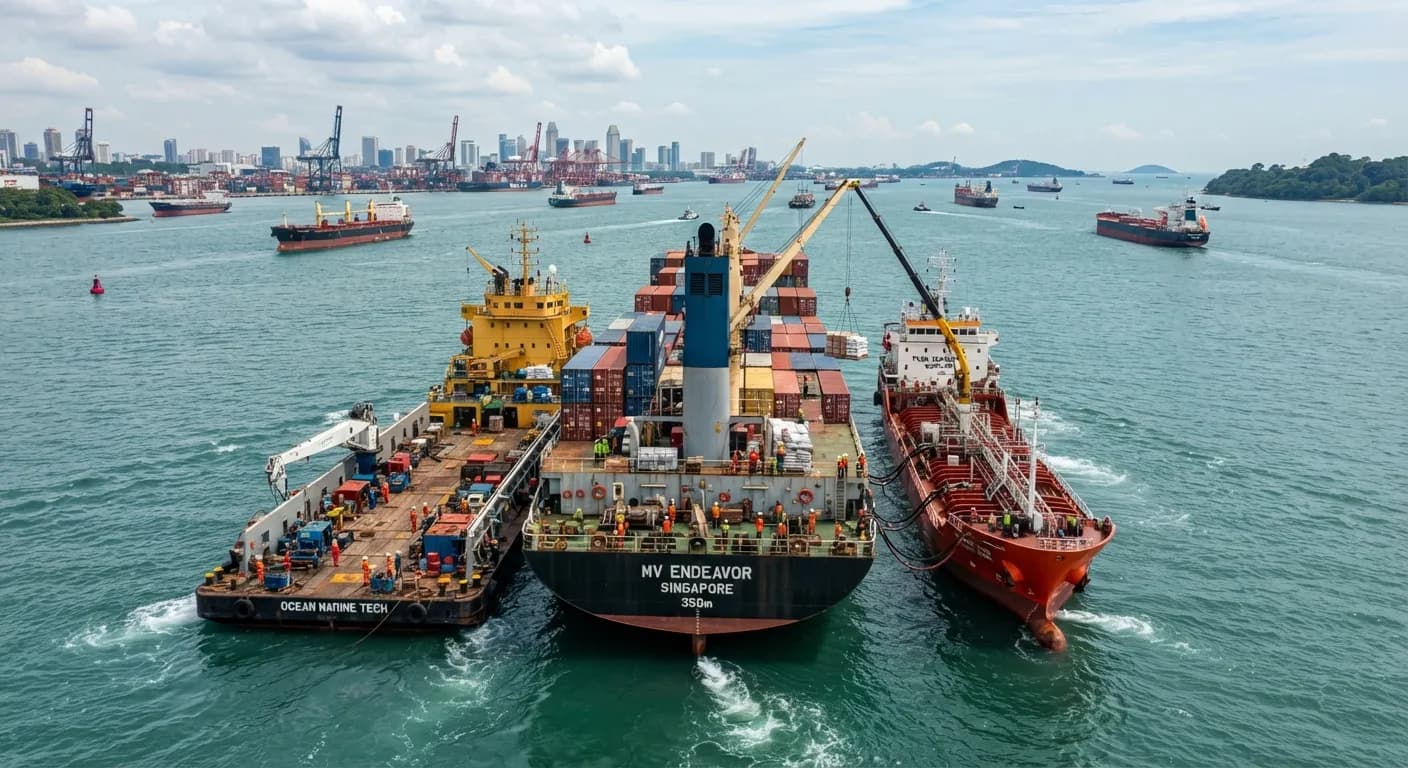
The Straits of Malacca and Singapore are among the busiest shipping routes in the world. A vessel passing through them has limited freedom to stop, change speed, or arrange services at short notice.
Singapore makes the transit easier to manage because it is also a major maritime service hub. Vessels can combine their passage with bunkering, provisions, spare parts, crew changes, technical services and repairs.
But combining a transit with a service call only works when the planning is done early.
A late requisition, an incorrect anchorage position or a change in the vessel's ETA can leave a launch boat waiting, require a second boat or delay a technician. The vessel then pays for additional boat time, fuel and, in some cases, lost charter time.
Some of the practical details behind these operations are difficult to learn from port information alone. To add that operational perspective, we spoke with Grag and Diana, colleagues with experience working with shipping companies. They shared examples and advice based on what they have seen in actual vessel operations.
One of the first things they point out is how important the agent is in Singapore:
Unlike Suez, Panama or the Turkish Straits, the authorities here set no fixed point where suppliers must deliver supplies or perform services. At Singapore and Singapore OPL, the agent organises every delivery and books the boats from launch operators. In Egypt and Turkey, each supplier usually delivers with its own boat.
This is why communication between the vessel and the agent is particularly important. The agent needs the vessel's ETA, position, delivery requirements and cargo details early enough to arrange the right boat and combine deliveries where possible.
Most avoidable delays begin with incomplete, late, or outdated information.
Navigation Factors That Shape Service Planning
Transit rules help determine the vessel’s ETA window at the OPL, so they should be part of the service plan from the start.
Vessels must follow the Traffic Separation Scheme and IMO rules for the Straits of Malacca and Singapore. Ships of 300 GT or more, ships 50 m or longer, and ships carrying hazardous cargo must report under STRAITREP. The reporting authority depends on the sector: Klang VTS covers Sectors 1–5, Johor VTS covers Sector 6, and Singapore VTS covers Sectors 7–9.
Deep-draught vessels and VLCCs must maintain an under-keel clearance of at least 3.5 m throughout the passage. They must also maintain a speed of 12 knots or less in designated areas, including One Fathom Bank, the Phillip Channel deep-water route, and parts of the Singapore Strait. These restrictions determine how fast a loaded deep-draught vessel can travel. The agent uses this information to plan the timing of service boat departures.
Pilotage in the straits is voluntary. The MPA publishes pilotage guidelines and a list of certified straits pilots. If the company’s procedures require a pilot for the vessel type, the agent should arrange the pilot together with the service call.
Security is another factor when deciding where the vessel should wait and how long it should remain there. ReCAAP ISC recorded 108 incidents in the straits in 2025, a 74% increase from 2024 and the highest number since 2007. Most incidents involved opportunistic theft during darkness, particularly between 20:00 and 06:00. Reported stolen items included engine spares, scrap metal, ship stores, and other unsecured items.
Grag gives the following advice for vessels transiting the straits:
Malacca is still considered a piracy area. The crew must stay alert and post additional lookouts during the transit.
A long wait at anchor can increase the vessel’s exposure. Once spare parts and ship stores are delivered, move them into locked storage spaces as soon as possible.
Bunkering in Singapore: Port or OPL?
The choice depends on whether the vessel already has a reason to enter port. Diana explains the logic:
If the vessel calls at Singapore anyway, for example to load or discharge, it is cheaper to take bunkers inside port limits. If the vessel has no port call, it is cheaper to anchor at Eastern or Western OPL and receive bunkers there. The barge costs less than a port call. The key point is to choose a bunker supplier licensed by MPA.
The Maritime and Port Authority of Singapore (MPA) licenses bunker suppliers, bunker craft operators and bunker surveyors. Since 1 January 2017, MPA-approved mass flow meters have been mandatory for all marine fuel oil deliveries in the Port of Singapore. The quantity recorded on the bunker delivery note is based on the barge meter reading. The vessel’s cargo officer, chief engineer and, where engaged, the bunker surveyor witness the reading.
Since 1 April 2025, all bunker suppliers in the Port of Singapore must provide digital bunkering by default, including electronic bunker delivery notes. These requirements apply to bunkering in the Port of Singapore. For an OPL delivery, confirm with the supplier in advance which measurement methods and documents apply.
Check the OPL Anchorage Before Ordering
The anchoring position needs to be checked before the vessel stops. This is particularly important for areas referred to as Singapore OPL East, because some of these waters are inside Malaysian territorial waters off eastern Johor.
The Malaysian Maritime Enforcement Agency has detained vessels for anchoring in these waters without written permission from the Director of Marine. The area may not be clearly identified on standard navigational charts. Gard advises operators to obtain the Malaysian 1979 Territorial Waters Chart through a local agent before anchoring. An investigation can keep the master ashore for one to three days or longer. The fine can reach MYR 100,000 per offence, and P&I cover may not respond.
Control Quantity and Quality During Delivery
Quantity and quality disputes remain a risk during bunkering. Grag describes some of the problems that can occur during delivery:
Bunkering in the Singapore area has always been a challenge. A bunker surveyor on board is no guarantee. The final figures can turn into a long dispute that often ends with a letter of protest from the vessel. Short deliveries in exchange for cash to the crew still happen. Some suppliers insist on fitting the sampler on the barge instead of the receiving vessel, and then swap it. The samples show good fuel, while the tanks hold off-spec fuel. No arbitration helps if the samples are good.
The same expert recommends three controls.
- Survey the barge before delivery.Carry out the inspection as a three-party team involving the vessel crew, bunker surveyor and barge crew.
- Keep control of the sampler. Fit it only on the receiving vessel and monitor it throughout the delivery.
- Check the barge tanks for the “cappuccino effect.” Entrained air can increase the apparent volume when the tanks are sounded, creating a difference between the measured and actual quantity of fuel.
What You Can Receive at OPL
Bunkering is not the only service that can be arranged at Singapore OPL. Most routine vessel supplies can also be delivered offshore. Diana mentions:
Singapore is one of the key ports for supplies, crew changes and services, so suppliers try to deliver as much as possible. The ship’s crane capacity is often the weight limit. It is also one of the best hubs for the balance of price and quality, with good prices on lubricating oils. The main point is to book the delivery boat in advance. Keep the agent informed of the vessel’s approach.
Most routine supplies can be delivered at OPL, but the type and size of the order determine whether the operation is straightforward or requires additional arrangements.
Swipe horizontally to view all columns
Delivery type | Examples | Main condition |
|---|---|---|
Usually feasible | Provisions, fresh water, spare parts, lubricating oils, stores, technical items | Boat booked in advance; lift within the ship’s crane capacity |
Needs approvals | Crew change, service engineers boarding, cash to master | Immigration and customs clearance arranged through the agent |
Difficult or uneconomic | Heavy or oversized parts, lifts beyond the ship’s crane, dangerous goods without permits | Port call or shipyard |
Crew changes need a briefing for both the joining and leaving crew. Grag points out a common issue:
Seafarers still need a reminder before a crew change: they must not bring cigarettes, IQOS or vapes into the country. The minimum fine is significant.
This is something the agent and crew should address before the crew change rather than after the joining crew arrives.
Supplies Underway
A vessel in a hurry can take supplies without anchoring. This works for both eastbound and westbound transits of the Singapore Strait.
The operation requires coordination between the agent, master, and shore office. Diana describes how it works:
The agent, the master and the office agree on the meeting coordinates. The crew updates the agent on the ETA throughout the approach. Near the meeting point, the vessel reduces speed to the minimum. The boat comes alongside and transfers the pallets while both run in parallel.
This option avoids the need for the vessel to anchor and wait for the delivery. However, it requires the order and transfer to be well prepared, because the delivery takes place while both vessels are moving.
The expert compares the two options as follows:
Swipe horizontally to view all columns
Factor | Supplies underway | Delivery at OPL anchorage |
|---|---|---|
Boat transit, one way | About 4 to 6 hours | About 12 hours |
Vessel time | Minimal stop | Anchoring and waiting |
Boat cost | Lower, due to shorter boat use | Higher |
Volume | About 40 to 60 lifts at most | Limited mainly by crane and time |
Risks | Harder working conditions, higher risk of losing a pallet, boat may cancel in bad weather | Weather still affects boat transfers |
The choice therefore depends mainly on the size and handling requirements of the order. Choose the underway option for a small, well-prepared order. Choose delivery at the OPL anchorage for large volumes or items that need careful handling.
Lead Times and Order Confirmation
Once the service plan is agreed, confirm the full order early enough for the agent to arrange one delivery boat for everything. This helps avoid separate boat trips and makes the operation easier to coordinate.
The required lead time depends on what the vessel needs:
- Provisions and stock spare parts usually require the shortest notice.
- Non-stock spare parts take longer because the supplier needs to source them and ship them into Singapore.
- For bunkers, the fuel grade, quantity, and delivery point must be agreed with a licensed supplier in advance.
For every call, the agent and suppliers need the same basic information:
- ETA, updated every time it changes
- Vessel particulars and the exact delivery point, either the anchorage name or coordinates
- Item list, including the number of pallets, cubic containers and gross weights
- Customs paperwork for spare parts in transit
- Crew lists and travel documents for a crew change, as well as the names of technicians who will board the vessel.
The delivery point needs particular attention. Giving the supplier the exact anchorage name or coordinates helps avoid confusion when the vessel is approaching and allows the delivery boat to plan the trip correctly.
Repairs require additional planning. For hot work at a Singapore anchorage, the Maritime and Port Authority of Singapore (MPA) advises applying online three days before the planned repair period. This requirement should be built into the repair schedule rather than handled at the last minute.
Repairs at OPL: Riding Team or Port Call
A riding team can handle most minor work while the vessel is at anchor or during the passage. Typical jobs include minor machinery repairs, valve and pump overhauls, electrical and automation troubleshooting, and some class-related surveys. The team can board the vessel at OPL and continue working until the vessel reaches its next port.
Some jobs require a port call or shipyard. These include major machinery overhauls, heavy lifts, and hull or underwater work that requires permits.
Hot work in Singapore port waters requires permission from the Port Master. Once the application is approved, MPA assigns a specific anchorage for the work. Hot work in the engine room workshop does not require prior permission.
There are also restrictions on what can be done at anchorage. MPA does not allow hot work at the anchorage on tankers carrying cargo or slops, or on tanks that are not gas-free. It also does not permit shell plate cutting on the ship’s side or deck hot work when dangerous goods containers are on board.
In Malaysian waters, welding, hot work and underwater operations also require prior permission from the Director of Marine.
The location of the anchorage also matters when technicians or surveyors need to board. Grag explains:
Eastern OPL is quite far from Singapore, 12 hours or more by speedboat. It is hard to send technicians or a class surveyor there. A crew change there is exhausting.
If the job requires a technician or surveyor, choose an anchorage that keeps the boat transit as short as possible. Before arranging a riding squad, also check the flag-state requirements and any applicable collective agreement rules to make sure the personnel can sail with the vessel.
Common Mistakes That Cost Time and Money
Many avoidable costs come from late or changed information. Diana describes the three cases the team sees most often:
The crew issues the supply requisition late, and the owner pays for an extra boat.
In another case, the vessel gave the agent its anchorage coordinates at Eastern OPL. It then moved while waiting for the boat and did not tell the agent. The owner paid for the boat’s waiting time and fuel while it searched the anchorage.
The third case is late information on the number of pallets or cubic containers. The agent then has to find a second boat urgently and at a higher price.
Other common mistakes can also add unnecessary costs. Operators sometimes book several launch boats for items that could have been carried together on one boat. Crew changes and technician boarding can be delayed because a required permit is missing. Boat transfers can also fail when nobody checks the weather and sea state for the planned delivery window.
The lesson is simple: the agent needs accurate information early enough to plan the entire call, rather than having to react to changes after the vessel is already at the anchorage.
Plan the Call Before the Vessel Enters the Straits
By the time the vessel enters the Straits, the main arrangements should already be in place. Before entering the Straits:
- Confirm all supply and service requirements.
- Give the agent the complete order early.
- Combine deliveries where one boat can carry them.
- Keep the agent updated on every ETA and position change.
- Confirm the exact anchorage coordinates and applicable jurisdiction.
- Choose the bunkering location based on the vessel's wider port schedule.
- Use appropriately licensed bunker suppliers and follow the required bunker procedures.
- Arrange crew-change and technician-boarding requirements in advance.
- Apply for hot-work permits early where required.
- Decide whether a small order can be delivered underway or whether anchoring is more practical.
- Check whether the planned repair can be completed by a riding team or requires a port call.
The earlier these decisions are made, the easier it is for the agent to combine services, book the right boats and avoid waiting time.
For the next Singapore call, shipping company managers can use Records Marine to compare ship chandlers, bunker suppliers, marine agents and repair contractors serving the area. Sending enquiries to several relevant vendors early also gives the operator more time to combine deliveries and select a suitable service arrangement.