IMPA Codes and the Marine Stores Guide: How to Standardize Fleet Procurement

When vessels order the same stores using different descriptions, comparing prices, checking supplier quotations and tracking spending across a fleet becomes difficult. Consider two requisitions for the same product: one vessel requests "PP rope 24 mm, 220 m coil", while another orders "polypropylene mooring line, 24 mm". Suppliers may treat these as different requests and quote different prices, even though both vessels need the same item.
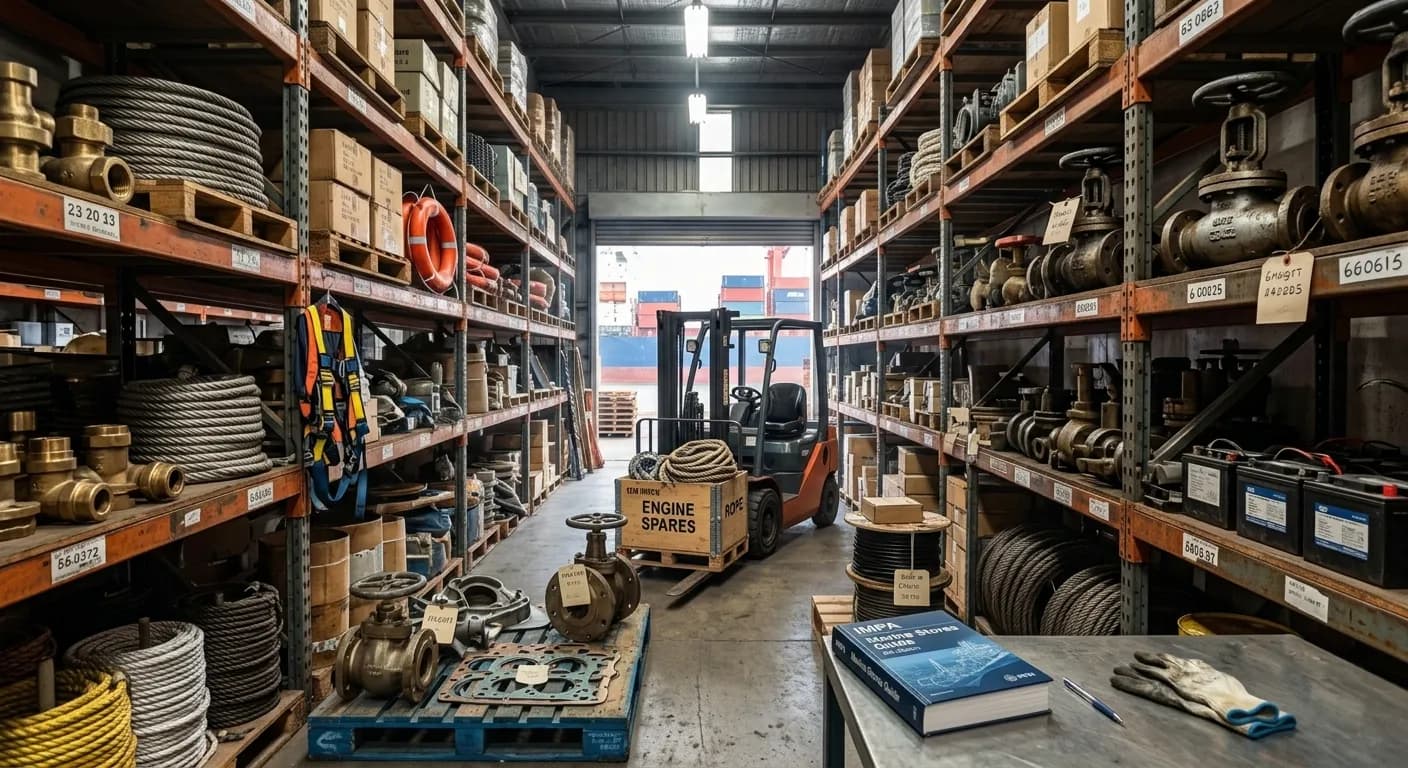
The IMPA Marine Stores Guide addresses this problem by assigning a single six-digit code to each item. When vessels, shore-based purchasing teams and suppliers use the same codes, everyone works from the same item definition, regardless of the port or vessel involved.
For purchasing managers, technical superintendents and fleet procurement teams, the guide can help standardize requisitions, simplify quotation comparisons, improve spend analysis and support fleet-wide purchasing agreements. But successful implementation requires more than adding codes to a purchasing system. Teams must also maintain consistent data, define ordering rules and understand where the system's coverage ends.
What Does the IMPA Marine Stores Guide Contain?
The Marine Stores Guide (MSG) is a coded catalogue of more than 50,000 marine stores items. Its categories include galley and cabin supplies, rope, deck equipment, paint, safety gear, hand tools, hardware, chemicals and other consumables. The current printed version is the eighth edition, and IMPA reports that the guide is used by more than 5,000 vessels and 300 shipping companies.
Choosing between the book, data licence and API
The guide is available in three formats. The right option depends on whether your team needs a reference catalogue on board or wants to integrate the data into a purchasing or enterprise resource planning (ERP) system.
Swipe horizontally to view all columns
Format | What it provides | Update frequency | Best suited to |
|---|---|---|---|
Printed book | Full catalogue with images and specifications | New edition every five years | Vessels and offices that need a physical reference copy |
Data licence | Full catalogue in Excel or CSV format, plus images | Data updates every six months, included in the licence | Owners and managers integrating codes into purchasing or ERP systems |
API | Live, cloud-based access to MSG data | Continuous | Procurement platforms and software providers |
The data licence for shipowners and managers is priced according to fleet size, with a minimum term of three years. A separate Publisher Licence is required to display IMPA codes on websites or in sales materials.
Software providers cannot supply systems with IMPA codes built in unless the user holds the appropriate licence. If your purchasing software already displays IMPA codes, confirm that your company or software provider has a valid licence.
How IMPA Codes Work
Every IMPA code contains six digits and identifies a specific item description. The digits are commonly displayed in three pairs, such as 21.02.01.
Swipe horizontally to view all columns
Code component | What it identifies | Example |
|---|---|---|
First pair | Section of the guide | 21 = Rope and Hawsers; 31 = Safety Protective Gear |
Second pair | Product group within the section | 21.02 = A group of synthetic fibre ropes |
Third pair | Individual item, including its size, material, rating or pack | 21.02.01 = A specific rope type and size |
The description linked to a code defines the item's specification. It identifies the material, dimensions, applicable standard or pack size that the supplier must match.
However, a code alone does not make an order complete. The buyer must still check the unit of measure and quantity. A code defines what the item is; the requisition must also state how many are required and in which unit.
Diana, maritime expert at RecordsMarine, points out that some catalogue entries require additional specifications. IMPA 752801, for example, is listed as "valve solenoid with further detail". Before sending a request for quotation (RFQ), the purchasing team should make sure the crew has provided all the necessary information, including dimensions where applicable. Otherwise, suppliers may quote an item that does not fit the vessel's requirements.
Standard catalogue descriptions may also differ from what a particular vessel needs. IMPA 211560 is described as "rope mooring 8ST marine-combi, 10-1/2" CIR x 200 mtr", but the required mooring-rope length depends on the vessel's design and drawings, so the crew may need to specify a different length in the requisition. Buyers should check that the supplier has quoted the requested length rather than the standard length in the catalogue description.
Keeping the data current is equally important. Descriptions change between editions: the eighth edition alone made more than 40,000 changes to existing codes and added over 3,000 new ones. Purchasing teams should review the change notes with each data release, as a code previously ordered under the seventh edition may now have a revised description.
The guide's main sections include cloth and linen, tableware and galley utensils, clothing, rope and hawsers, rigging and deck items, marine paint, painting equipment, safety protective gear, safety equipment, hose and couplings, nautical equipment and medicine. Later sections cover hardware, hand and power tools, measuring tools, metal stock, fasteners, pipes and machinery equipment.
What Fleets Gain From IMPA Codes
A shared item code turns a free-text description into a defined specification. This affects the entire procurement process, from the first requisition to the final invoice.
Swipe horizontally to view all columns
Procurement stage | Without a shared code | With IMPA codes |
|---|---|---|
Requisition | Each vessel writes its own description | Crew select an item from a coded list |
Request for quotation (RFQ) | Suppliers interpret descriptions and may quote different items | Suppliers quote against the same specification |
Quote comparison | Prices cannot be compared reliably line by line | Line prices can be compared across suppliers and ports |
Delivery check | Crew must judge whether the delivered item matches the request | Crew check the code and description on the delivery note |
Spend analysis | The same item appears under multiple names | Spending can be grouped by code, section and vessel |
Contracts | Price agreements cover vaguely defined item groups | Framework prices apply to specific codes |
Standardized codes also help fleet teams negotiate purchasing agreements. A framework agreement listing IMPA codes and prices by port gives vessels a clear basis for ordering.
How to Roll Out IMPA Codes Across a Fleet
Introducing IMPA codes across a fleet is primarily a data-management project before it becomes a purchasing-process project. Much of the work involves cleaning up the existing item list, matching entries to codes and establishing rules that prevent teams from returning to inconsistent free-text descriptions.
- Secure the appropriate licence. Confirm whether your company or software provider holds the MSG Data Licence. It covers loading codes into the purchasing system and receiving six-monthly data updates.
- Export your existing item master. Extract every stores item ordered during the previous two to three years. Include its description, unit of measure, vessel and supplier.
- Map items to IMPA codes. Match each existing item to the correct code and merge duplicate entries describing the same product. Flag items that have no IMPA equivalent.
- Load the codes into your systems. Import the codes and descriptions into the purchasing or planned maintenance system, both ashore and on board. Make sure every vessel uses the same data version.
- Establish ordering rules. Require IMPA codes for items in covered sections and allow free-text orders only by exception, with office approval. Do not let crew members create new item entries directly in the onboard purchasing system: if a required item is missing from the catalogue, the shore-based office should create and approve the entry first, and the crew can then add it to a requisition. This keeps the item master under central control while still allowing vessels to order items the catalogue does not cover.
- Create standard lists for each vessel type. Define approved items for safety gear, deck stores, galley stores and cleaning chemicals. Set minimum and maximum stock levels against each code.
- Update supplier terms. Require suppliers to quote using the IMPA code, unit of measure and item description. Any proposed substitute should be identified in the quotation, not revealed only when the delivery arrives.
- Train the crew. Show masters, chief engineers and chief cooks how to raise requisitions using codes and verify deliveries against the relevant code and description.
- Manage data updates. Review the change notes in each release and update fleet standard lists whenever an item description changes.
For the initial rollout, focus on high-volume categories such as rope, marine paint, safety gear, cleaning chemicals and galley stores. These categories generate repeat orders, which makes them a useful starting point for improving consistency and comparing prices.
IMPA or ISSA?
Some suppliers work with the ISSA Ship Stores Catalogue, a parallel coding system published by the International Shipsuppliers & Services Association, rather than with IMPA codes. The two systems are not interchangeable, so agree with each supplier which catalogue their quotations will reference and keep that choice consistent across the fleet's standard lists.
Where the IMPA Code System Stops
IMPA codes cover marine stores and consumables, but they do not replace manufacturer part numbers for machinery spares. Components for main engines, pumps, compressors and separators still need to be ordered using the original equipment manufacturer's (OEM) part number, drawing reference and equipment serial number. Several other limitations also need controls.
Swipe horizontally to view all columns
Gap or error | Potential consequence | Recommended control |
|---|---|---|
OEM machinery spares ordered by IMPA code | Wrong part or wrong manufacturer | Order using the maker's part number and equipment serial number |
Item has no IMPA code | Purchasing reverts to free-text descriptions | Assign an internal code and submit the item through IMPA's code enquiry process |
Brand matters, but only the code is specified | Supplier delivers a different brand that matches the general description | State the required brand or approval on the order line |
Unit or pack size is not checked | An order for 10 rolls arrives as 10 metres | Fix the unit of measure against each code in the item master |
Vessels use different data versions | Office and vessel interpret the same code differently | Distribute each data release to all vessels at the same time |
Codes are used in software without the required licence | Potential copyright breach and loss of access to data updates | Confirm licensing with your software provider |
A code defines the item specification, but it does not guarantee the quality or compliance of a particular delivery. Class-approved and type-approved products, including lifesaving appliances and firefighting equipment, still require the correct certificates when delivered.
Suppliers may also propose alternatives even when a requisition includes an IMPA code, and they often describe these substitutions only in the remarks section of their quotations. Review those notes before approving an order, confirm that the proposed product meets the vessel's requirements and obtain the vessel's approval where necessary. A similar-looking item is not necessarily a suitable replacement, and accepting an unsuitable alternative can lead to additional costs, returns or delays.
Using Coded Procurement Data Beyond the Purchase Order
Once every stores line carries an IMPA code, the same standardized data can support more than purchasing. It can also improve compliance documentation, sustainability initiatives, spend reporting and supplier management.
Supporting the inventory of hazardous materials
Ships covered by the EU Ship Recycling Regulation and the Hong Kong Convention must maintain an up-to-date Inventory of Hazardous Materials (IHM). For relevant items, suppliers must provide a Material Declaration (MD) and a Supplier's Declaration of Conformity (SDoC). Coded purchase lines make it easier to identify which items require these documents, and IMPA has offered an IHM documentation service as an extension of the MSG Data Licence; check with IMPA whether it is currently available and on what terms.
Using sustainability indicators
The IMPA Marine Stores Guide identifies lower-impact alternatives for selected items. Fleet procurement teams can use these indicators when reviewing and updating their standard lists. A marked alternative should not automatically replace an existing product, however: before making a change, check that the alternative fits the intended application, performs as required and meets any applicable approval requirements.
Improving spend reporting and supplier reviews
With coded purchasing data, shore-based teams can report spending by IMPA section, vessel, port and supplier. These reports help procurement managers:
- Compare prices for the same code across different ports and suppliers.
- Identify vessels ordering items outside the fleet's standard list.
- Measure the proportion of purchase lines that still use free-text descriptions.
- Review how frequently suppliers substitute items for those specified in the order.
Diana adds that linking purchase histories to IMPA codes also makes it easier to analyse price changes for the same products over time. Procurement teams can identify suppliers that maintain relatively stable prices, those that introduce sudden increases and those whose prices fluctuate frequently. This analysis can guide the next round of market research: if the available quotations do not say enough about a particular region, buyers can collect more prices there and compare offers from suppliers operating in the same area. Over time, this creates a clearer picture of regional price differences and helps teams judge whether a quotation is competitive.
The MSG API provides live access to catalogue data. According to IMPA, access is being rolled out first to procurement platforms and data resellers. Ask your software provider whether your system uses the API or relies on periodic file updates.
IMPA Code Rollout Checklist
Before making IMPA codes mandatory across your fleet, use this checklist to confirm that the data, systems and supplier processes are ready.
- Confirm who holds the MSG Data Licence: your company or your software provider.
- Export the existing stores item master, including descriptions, units, vessels and suppliers.
- Map items to IMPA codes and merge duplicate entries.
- Assign internal codes to items without an IMPA equivalent.
- Define the unit of measure for each code.
- Load the same data version into shore-based systems and every vessel.
- Make IMPA codes mandatory for requisitions in covered sections.
- Build standard lists for each vessel type, starting with high-volume categories.
- Require suppliers to quote by code and flag substitutes in their quotations.
- Agree with each supplier whether IMPA or ISSA codes will be used.
- Continue ordering OEM machinery spares using manufacturer part numbers.
- Identify purchase lines requiring MD and SDoC documentation for the IHM.
- Review the change notes in every six-monthly data release.
Tender Coded Stores Orders Through RecordsMarine
Standardized item codes deliver the greatest value when multiple suppliers quote against the same list. RecordsMarine lets fleet teams shortlist ship chandlers and marine stores suppliers by port and request quotations against item lists coded to the IMPA Marine Stores Guide. Send your fleet's standard item list to suppliers in the ports your vessels visit, and compare their prices line by line using the same codes before signing a framework agreement.