Navigating the 2026 STCW Amendments: What Crew Managers Need to Know

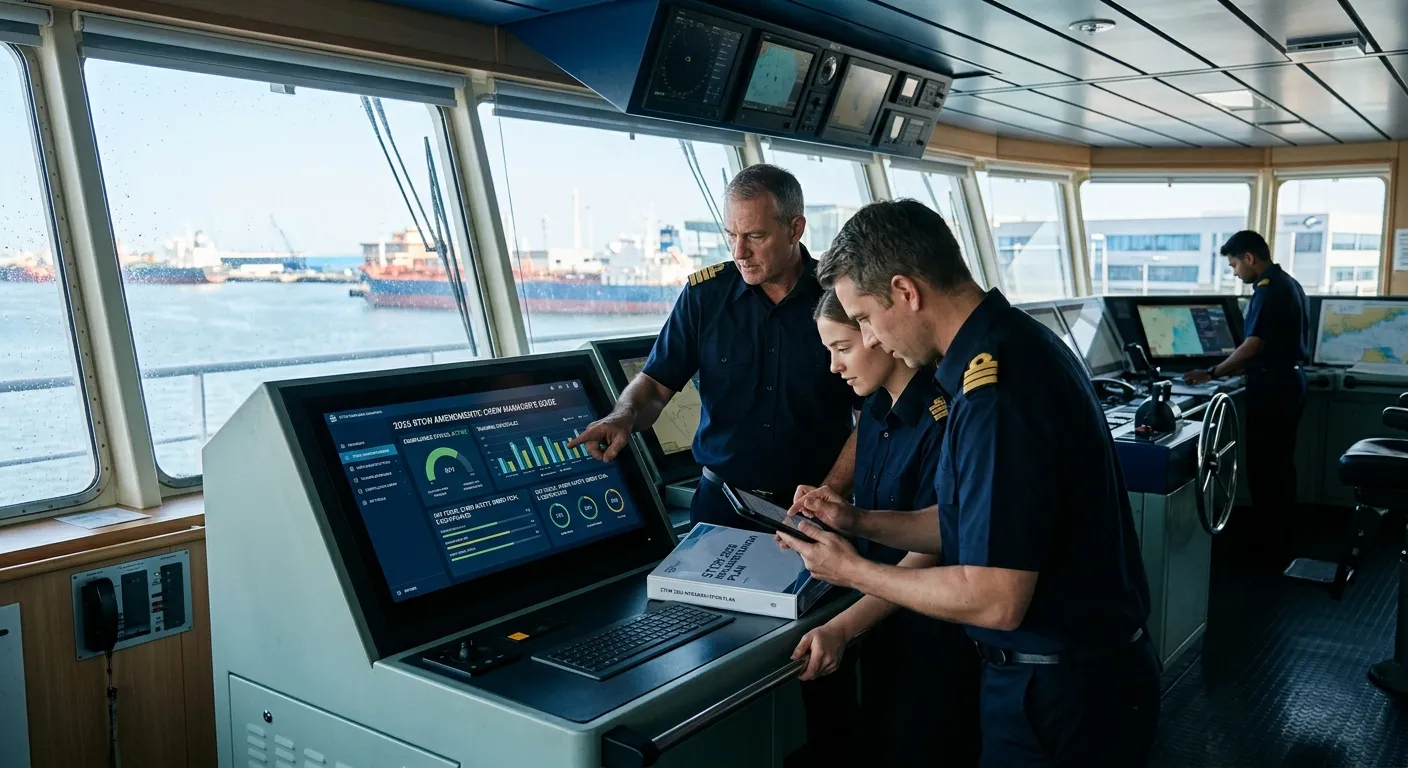
Seafarer training requirements changed on 1 January 2026. Since that date, Basic Safety Training must include instruction on preventing and responding to violence and harassment.
Other changes are also on the horizon. The International Maritime Organization (IMO) has approved interim training guidelines for alternative fuels, while a broader review of the STCW Convention and Code is underway.
For crew managers, keeping up with these developments is not just about understanding new regulations. Different flag states have taken different approaches to existing certificates and transition periods. Companies managing crews across several registries must therefore track multiple requirements and deadlines.
So, what has changed, what is still under development, and what should crew managers do now? Let's look at the key developments and their practical implications.
What Changed on 1 January 2026?
The main change comes from IMO Resolution MSC.560(108), adopted in 2024. It amends Table A-VI/1-4 of the STCW Code, which sets the minimum competence requirements for Personal Safety and Social Responsibilities (PSSR). PSSR is one of the four modules included in Basic Safety Training.
Under the updated requirements, training must cover how to prevent and respond to violence and harassment. This includes sexual harassment, bullying and sexual assault.
The other three Basic Safety Training modules remain unchanged. Seafarers also do not receive a separate certificate for the new content. Instead, it becomes part of the existing PSSR or Basic Training certificate.
Another change took effect on the same date, this time affecting personnel serving on fishing vessels. Amendments to the STCW-F Convention and the new mandatory STCW-F Code entered into force on 1 January 2026.
Until now, STCW-F had no mandatory technical code comparable to the STCW Code for merchant ships. The revision introduces one, with Part A setting minimum competence standards for fishing vessel personnel and Part B providing guidance on training, certification and assessment.
The goal is to harmonize qualifications across participating countries, allowing certificates to be recognized between Parties and making it easier for fishing crews to move between flags. Companies supplying crews to fishing fleets should therefore treat these requirements as a separate compliance matter.
Who Needs the Updated PSSR Training?
The new requirement applies to every seafarer who completes or renews Basic Safety Training on or after 1 January 2026.
For new entrants, the updated content must be included in their initial Basic Safety Training course. Existing seafarers will receive the training when they attend a refresher course or renew their certification, unless their flag administration or employer requires them to complete it earlier.
The updated module also focuses on reporting violence and harassment. Seafarers should know which reporting channels are available, including the Master, the Designated Person Ashore (DPA), the flag administration and port welfare services.
This requirement has practical implications for shipping companies. Their Safety Management System (SMS) should clearly explain how seafarers can report incidents. These procedures must also work in practice. For example, if a seafarer is instructed to report an incident to the DPA, the company needs an effective process for handling that report.
Certificate renewal dates matter, too. Consider a seafarer whose PSSR certificate expired in December 2025 and was renewed in January 2026. The renewed certificate must meet the updated requirements. The renewal date determines which rules apply, not the date when the original certificate was issued.
Flag States Have Different Transitional Rules
The IMO set the new training requirement but no universal transitional rule for existing certificates. Each flag administration decides how the amendment applies to seafarers who already hold valid certification. The positions below show why crew managers need to check the rules for each registry.
Swipe horizontally to view all columns
Flag state | What happens to existing certificates? | What else is required? |
United Kingdom | PSSR certificates dated before 1 January 2026 remain valid. Their holders, and all holders of UK CoCs and CoPs, must still complete supplementary training on the new competence. | Complete the free MCA-arranged online module by 31 March 2027. Holders of a PSSR certificate dated on or after 1 January 2026 are exempt. The MCA accepts MSC.560(108) training from an IMO White List flag if dated before 18 August 2026. |
Liberia | The advisory ties the requirement to training completed or renewed on or after 1 January 2026. | Seafarers renewing Basic Training on or after that date must renew Fire Prevention and Fire Fighting, Personal Survival Techniques, and PSSR with the new content. |
Marshall Islands | Existing Basic Training Special Qualification Certificates remain valid until the seafarer’s Identification and Record Book expires. | PSSR started on or after 1 January 2026 must include the new competence. The PSSR component must be refreshed at Basic Training renewal. |
Malta | Basic Safety Training CoPs issued before 1 January 2026 remain valid until their stated expiry date. | Course completion certificates submitted from 1 January 2026 must state “as amended by IMO Resolution MSC.560(108)”. |
Hong Kong | Holders of PSSR certificates issued before 1 January 2026 do not need additional training. | Companies are encouraged to provide guidance in line with MSC.560(108). |
Cook Islands | Certificates issued before 1 January 2026 remain valid. | MCI may request evidence that certificates issued later include the updated content. |
Tuvalu | Existing certificate holders are considered compliant for the time being. | All seafarers must hold a compliant Basic Training certificate by 31 December 2026. The Master must also deliver and record PSSR training on board. |
Two registries have set firm deadlines for existing seafarers. Tuvalu requires all seafarers to hold compliant Basic Training certificates by 31 December 2026. In the UK, the deadline for completing the supplementary module is 31 March 2027. Crew managers should identify any outstanding training needs and arrange the necessary updates well before these dates.
However, flag-state requirements can change. The UK initially exempted existing seafarers under MIN 729. Following HTW 12, the Maritime and Coastguard Agency (MCA) replaced that notice with MGN 718, extending the requirement to all PSSR certificate holders. Other flag administrations may revise their guidance in the same way. Always check the latest circular before relying on the requirements listed above.
Documentation requirements also vary. Malta requires course completion certificates to explicitly reference MSC.560(108), while Liberia and the Marshall Islands link the updated content to Basic Training renewal. Crew managers should confirm that their training centres issue certificates in the format accepted by each flag administration.
Inspections may also focus on whether training providers have updated their course materials and whether companies have incorporated the new requirements into their Safety Management System (SMS).
Finally, flag-state rules are not the only requirements to consider. An employer or another flag administration may require a seafarer to complete the updated PSSR training before the applicable transitional deadline. Crew managers working with multiple shipowners or principals should therefore track each principal's requirements alongside those of the relevant flag state.
Alternative Fuel Training: What Crew Managers Should Know
As ships adopt alternative fuels, seafarers need new skills to handle them safely. The IMO is developing training guidance to help address these needs.
In May 2026, the IMO's Maritime Safety Committee (MSC 111) approved two interim training guidelines. One covers ships using methyl or ethyl alcohol as fuel, while the other addresses ships using ammonia.
These guidelines build on a broader framework established in STCW.7/Circ.25, approved at MSC 110 in 2025. The circular provides a general structure for training personnel serving on ships that use alternative fuels and new technologies. The newer guidelines add specific training modules for methanol and ammonia.
It is important to understand the status of these guidelines. They are not mandatory STCW requirements. Instead, they give flag administrations and training providers a common approach while the IMO develops mandatory standards.
The training covers practical topics such as fuel properties, bunkering and fuel transfer, engine operation, leak detection, emergency response and personal protective equipment (PPE).
The IMO is also planning further guidelines for hydrogen fuel cells, liquefied petroleum gas (LPG), hydrogen, battery power and wind propulsion.
For crew managers supplying seafarers to vessels powered by methanol or ammonia, the next step is to consult the shipowner and confirm which interim guideline the flag administration will accept.
Keeping training records aligned with the IMO framework can also make future compliance easier. When mandatory requirements are introduced, companies will have a clearer picture of which training their seafarers have already completed and what additional instruction may be needed.
The Wider STCW Review Is Still Underway
The changes to PSSR are only one part of the IMO's work. The organization is also reviewing the entire 1978 STCW Convention and Code, a much broader process that could reshape seafarer training requirements. The review began with a first phase focused on identifying gaps. That phase concluded at the 11th session of the Sub-Committee on Human Element, Training and Watchkeeping (HTW 11) in February 2025.
The second phase focuses on revising the Convention and Code. It began after MSC 110 endorsed an updated road map.
HTW 12 met from 23 to 27 February 2026 and started reviewing competence requirements for deck and engine personnel. The sub-committee also considered new provisions addressing emerging risks and operational developments.
Several questions remain open. These include when training must receive formal approval from the relevant administration and which new teaching methods the STCW framework will recognize. An intersessional working group continued the work from 2 to 6 March 2026. Its findings will be submitted to HTW 13 in 2027. The current work plan extends to 2029, and the revised Convention will not enter into force immediately after its adoption. Crew managers should therefore not expect a new certificate structure before the end of the decade.
The review also covers regulatory oversight. HTW 12 continued work on integrating STCW oversight with the IMO Member State Audit Scheme and improving the reporting of certificate fraud through the Global Integrated Shipping Information System (GISIS).
For now, the priority is to monitor these developments rather than anticipate immediate changes to existing certificates.
Fatigue and Hours of Rest Are Also Under Review
Seafarer fatigue is another issue on the IMO's agenda. At the direction of the MSC, HTW 12 began assessing whether the current rules on hours of work and rest remain fit for purpose. The review covers both the STCW Convention and the Maritime Labour Convention (MLC), as well as how their requirements are enforced. A correspondence group will continue the work before HTW 13.
No changes to hours-of-rest rules have been introduced as a result of this exercise. However, future amendments could affect manning levels and crew rotation schedules. Crew managers should keep track of this work alongside the wider STCW review. Including both topics in compliance planning will help companies prepare if new requirements emerge.
What Crew Managers Should Do Now
The immediate work is largely administrative. Most of the work involves checking existing records, confirming the rules that apply to each vessel and making sure training procedures are up to date. The following steps can help identify gaps and prioritize action.
- Review PSSR and Basic Training certificates. Record each seafarer's certificate issue and expiry dates. Then compare them with the flag of the vessel they currently serve on and the flag of their next assignment.
- Check the rules for each relevant flag state. Collect the latest circular on MSC.560(108) from every flag administration represented in the fleet. Check whether individual shipowners or principals have additional requirements.
- Prioritize fixed deadlines. Pay particular attention to flag states with specific deadlines in 2026. For Tuvalu, this means ensuring that all seafarers hold compliant Basic Training certificates by 31 December 2026.
- Confirm that training centres have updated their courses. Check that the providers used for Basic Training have incorporated the revised PSSR content. Make sure the changes are documented on the relevant certificate or course record.
- Review SMS reporting procedures. Ensure that the SMS clearly explains how seafarers can report violence and harassment, including through the DPA. If the applicable flag state requires the Master to deliver training on board, verify that the corresponding records are in place.
- Prepare for alternative fuel assignments. For vessels using methanol or ammonia, agree with the shipowner and flag administration on the applicable interim training guideline. Maintain the relevant course records.
The broader STCW review and the fatigue assessment will not change certificate requirements this year. Nevertheless, both should remain on the company's compliance calendar. The next major checkpoint is HTW 13 in 2027, when further developments in the wider review are expected to be considered.
For crew managers, the immediate goal is clear: ensure that the updated PSSR requirements are covered, understand how each flag state handles existing certificates, and monitor developments that could affect future training standards.
A well-maintained compliance calendar and accurate training records will make it easier to manage these responsibilities as the regulatory framework evolves.