How to Execute a Seamless Crew Change at Major Hubs

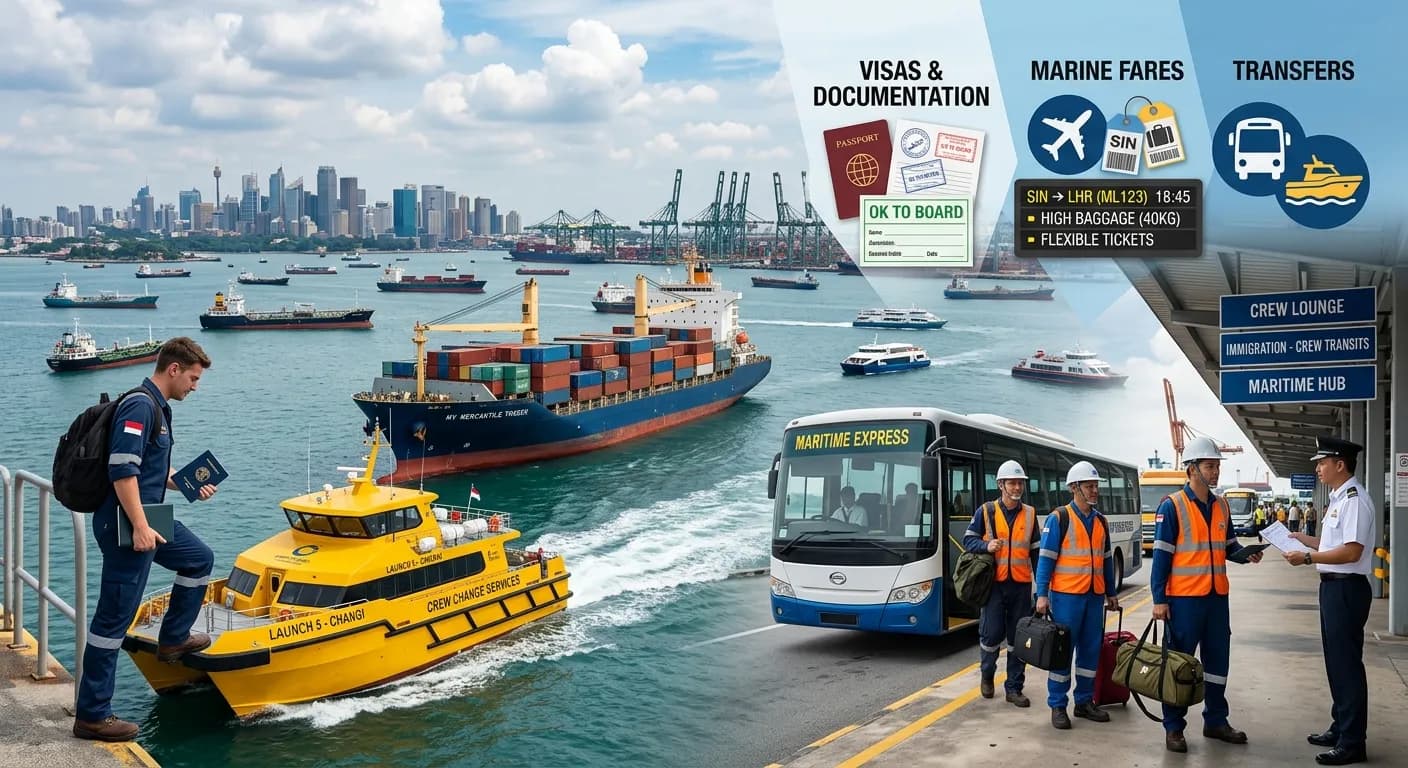
Major maritime hubs can make crew changes easier. They usually offer frequent flights, experienced port agents, established immigration procedures, and regular vessel calls. Many operators plan crew rotations around calls at major ports or canal transits.
However, a crew change can still become complicated if one part of the process is not ready. A vessel may have to wait for a replacement, flights may need to be rebooked, or an off-signer may remain on board longer than planned.
Contract limits also need to be considered. The ILO position, as applied by the Australian Maritime Safety Authority (AMSA), is that a seafarer should not remain on board for more than 11 months without leave. The Maritime Labour Convention (MLC), Standard A2.5.2, also provides that the period of service on board before a seafarer is entitled to repatriation must be less than 12 months.
A successful crew change therefore depends on more than booking flights. The vessel, crew, agent, immigration authorities, airline, and transfer provider all need to be coordinated around the same schedule.
Plan the Crew Change Around the Vessel's ETA
Start planning as soon as the crew change is confirmed.
First, confirm the vessel's expected time of arrival (ETA), berth or anchorage, and expected time alongside. Then nominate the crew change agent and check the immigration, visa, and flag endorsement requirements for the joining crew.
Flights should preferably be booked with marine fares where they are available. The agent should also notify the port and immigration authorities and arrange any required hotels and ground transport.
The ETA can change frequently because of weather, cargo operations, and berth congestion. Build the crew change plan around an ETA window rather than a single fixed date. Ask the agent how late flights and immigration filings can be amended without a penalty.
Notice periods also vary by port and authority. Confirm the applicable deadline with the local agent before submitting documents or booking travel.
Prepare Documentation for On-Signers and Off-Signers
The documentation depends on whether the seafarer is joining or leaving the vessel.
On-signers
The joining seafarer will normally need:
- Passport
- Seaman's book
- Certificate of Competency and required flag endorsements
- Medical certificate
- Seafarer's Employment Agreement
- Visa, if required for the nationality and port
Check the flag endorsement requirements early. If an endorsement is not ready, ask the flag administration or agent whether a temporary document can be used.
Off-signers
The departing seafarer may need:
- Passport
- Seaman's book
- Discharge records
- Transit visa, where required
The agent will also need the crew list and travel details. Some ports require an OK-to-board letter confirming that the seafarer is travelling to join the vessel.
Do not wait until the flight date to check these documents. A missing visa, endorsement, or immigration document can prevent a seafarer from joining or leaving the vessel even when the flight is confirmed.
Crew Change Requirements at Major Hubs
The basic planning process is similar at most major hubs, but immigration and transfer procedures can be very different. Always confirm the current requirements with the local crew change agent.
Singapore
Singapore is a major crew change hub, but the procedure depends on where the crew member enters or leaves the country and where the vessel is located.
The Maritime and Port Authority of Singapore (MPA) facilitates international crew changes through the ICA Crew System via digitalPORT@SG.
For crew disembarking from port premises, a January 2026 notice requires them to proceed directly to the relevant ICA crew office. Crew members who have no duties or valid reason to go ashore must remain on board.
The exact procedure also depends on the vessel's location, such as a port facility, shipyard, anchorage, or offshore location. The agent should confirm the applicable procedure before the crew change.
Immigration status is also important. Crew with In-Principle to Land status must report to an ICA sea checkpoint or gazetted marina. Crew with Not to Land status must remain on board unless the agent, master, owner, or charterer applies to have the restriction lifted.
For crew landing at shipyards, wharves, or other non-gazetted installations, a later advisory requires them to clear immigration by sea route first.
Failure to follow these requirements can result in prosecution or suspension of the CREW account.
Crew members entering Singapore must also submit the SG Arrival Card within three days of arrival, including the day of arrival.
Rotterdam
Rotterdam is another major crew change hub, with access to a large port and international airports.
Immigration requirements depend on the seafarer's nationality and whether the crew member needs to enter the Schengen Area. If a Schengen visa is required, arrange it well before the planned crew change.
For example, the Spanish consulate in Mumbai allows applications up to nine months before travel and requires documents such as an invitation letter, seaman's book, and travel insurance.
The Entry/Exit System (EES) was fully deployed on 10 April 2026. FONASBA has noted that the system applies to crew changes, so additional time should be allowed for border procedures.
Medical arrangements should also be clear before arrival. In a medical emergency, the Harbour Coordination Centre and Port Health can assist. At sea, medical support is available through Netherlands Radio Medical via the Coast Guard, while the decision to evacuate remains with the duty doctor.
Fujairah
Fujairah is a major bunkering hub on the UAE's east coast and is also used for crew changes, particularly at anchorage.
Crew arriving for a change may travel through Dubai, Sharjah, or Abu Dhabi airports before transferring to the vessel.
Anchorage transfers need to be planned carefully. The Fujairah Port Authority's Dibba guide states that lifeboats must not be used to transfer personnel at anchorage.
The same guide specifies a 72-hour notice period and a minimum notice period of 48 hours.
Some sources have also reported a 96-hour crew transit visa, with applications submitted one to two working days before travel. However, one of these sources was last updated in 2022, so the current visa and notice requirements should be confirmed with the local agent before making arrangements.
Panama
Crew changes around the Panama Canal commonly take place at Balboa or Cristobal anchorages before or after the canal transit.
Foreign seafarers joining a vessel generally use a Visa Especial de Marino. The local agent applies to the National Migration Service under the applicable procedure.
Since 2023, the application has been handled electronically by the agent. The procedure at that time allowed applications of up to seven days. Local agents now report that crew from restricted nationalities may need to apply at least 15 business days in advance.
Another local husbandry agent reports a 48-hour deadline for uploading documents to the Panama Maritime Authority portal.
Because these deadlines can vary by nationality and current procedure, confirm them with the local agent before booking travel.
Nationality can also affect the crew change. Panama may require a custodian or escort for certain nationalities. The requirement may apply first to on-signers arriving by air and later to off-signers.
The agent normally arranges the custodian and pays the applicable hourly cost. Ask for the current list of nationalities affected and any available exemptions.
Gibraltar
Gibraltar is outside the Schengen Area, so a Schengen visa does not automatically provide entry to Gibraltar.
Check the entry requirements for each seafarer's nationality with the local crew change agent before booking travel.
Other visa and immigration cases
Some crew changes require specific national visas.
For example, a seafarer joining a vessel in a US port generally needs a crewmember D visa together with a C-1 transit visa, or a combined C-1/D visa.
A D visa holder must normally leave the United States on the vessel within 29 days.
Most applicants also need an interview, so appointment availability should be included in the planning schedule.
The exact requirements depend on the destination, the seafarer's nationality, and whether the person is joining or leaving the vessel. Check these requirements before confirming the travel arrangements.
Confirm Whether the Crew Change Is at a Berth or Anchorage
The transfer arrangements depend heavily on the vessel's location.
A berth is generally simpler because the crew can walk ashore through the terminal after completing the required immigration procedures.
An anchorage requires a launch or another approved transfer method. Sea state, visibility, weather, and port restrictions can affect whether the transfer can take place.
Confirm the permitted transfer method with the agent before booking the crew's travel. The transfer window should also include enough time for delays.
Plan Anchorage Transfers Carefully
Anchorage crew changes require more coordination than changes at a berth.
Arrange the launch early and check the expected sea state and weather conditions. If possible, keep a backup transfer window in case the first attempt cannot take place.
Confirm any local restrictions on personnel transfers and coordinate the launch with the other services planned for the vessel.
Sea state and visibility can stop or restrict a transfer even when all crew and travel documents are ready. The agent should therefore confirm the transfer conditions as close to the operation as practical.
Book Flights With the Crew Change in Mind
The cheapest flight is not always the most suitable option for a crew change. A flight that cannot be changed may become expensive if the vessel's ETA moves.
When booking flights, check the following:
Swipe horizontally to view all columns
What to check | What to do |
Fare type | Prefer marine fares where available. |
Changes and refunds | Check the fare's change and refund conditions before booking. Do not assume that every marine fare is fully flexible. |
Backup options | Avoid tight connections and ask the travel agent for a backup routing. |
Baggage | Confirm the baggage allowance before booking. Seafarers may need more baggage than standard economy tickets allow. |
Eligibility | Check whether the airline requires proof that the traveller is joining or leaving a vessel. The seaman's book or a letter of employment may be accepted. |
Airline requirements | Some airlines, including KLM, Air France, and SAS, require the employer to enrol in their corporate loyalty programme for marine fares. |
Booking channel | Low-cost carriers do not offer marine fares. Specialist travel management companies sell them, while standard booking sites do not. |
Marine fares are one-way airfares designed for people travelling to work on a vessel. ATPI reports that these fares usually allow changes without fees and may offer a full refund before departure, but conditions vary between airlines. Some carriers still charge change fees. Baggage allowances also vary. Some marine fares provide 40 kg or two 23 kg pieces, while others may allow an additional piece. No individual bag should normally exceed 32 kg. Standard economy fares may provide only one 23 kg bag. Low-cost carriers generally do not offer marine fares. Specialist travel management companies may therefore be a better option when flexible crew travel is required.
Arrange Hotels and Ground Transport
Accommodation and ground transfers should also leave some room for delays. Check these points when arranging the crew’s stay and transport.
Hotel and transport arrangements should allow for changes in the vessel's schedule.
For on-signers, book flights as close as practical to the vessel's expected arrival while leaving enough time for immigration and the transfer to the vessel.
For off-signers, a same-day flight may be possible if the transfer from the vessel allows enough time. This can reduce unnecessary hotel nights.
At the same time, avoid creating a schedule that leaves no room for delays. A small amount of flexibility can prevent a missed flight and an additional hotel stay.
Several problems occur repeatedly during crew changes. Most can be reduced with early planning and regular communication.
Swipe horizontally to view all columns
Risk | Mitigation |
|---|---|
The vessel's ETA changes | Track the ETA daily and use flexible travel arrangements where possible. |
The visa or flag endorsement is not ready | Start the application when the seafarer is nominated. Do not rely on the final travel date to complete the paperwork. |
A flight is delayed or cancelled | Allow enough time between the flight and vessel transfer and keep a backup routing where practical. |
An off-signer cannot leave the vessel | Send the complete crew documentation to the agent in advance and confirm the seafarer's immigration status before arranging the final transfer. |
The launch is unavailable, or weather prevents the transfer | Plan a transfer window with some flexibility and have a backup option where possible. |
An on-signer drops out at the last minute | Arrange a replacement as quickly as possible. If necessary, the current off-signer may need to remain on board until the replacement arrives. |
If a seafarer agrees to stay on board longer, record the extension in writing, including the new relief date and any change in pay. Check the applicable flag-state requirements before extending the employment period. For example, the Marshall Islands addresses extended employment agreements in Marine Notice 7-052-2. Keep the total period on board within the applicable maximum service period.
Allow Time for the Handover on Board
The crew change is not complete when the new seafarer reaches the vessel. The handover also needs to be planned.
Senior officers and key ratings usually need the longest overlap. The master, chief officer, chief engineer, and second engineer may require additional time to complete a proper handover.
The outgoing officer should brief the incoming officer on:
- Open defects
- Cargo status
- Planned maintenance
- Other important operational matters.
The incoming officer should also have enough time to become familiar with the vessel and its equipment before sailing.
Record the handover in the vessel's safety management system.
Plan the Entire Crew Change Before Booking Travel
A reliable crew change depends on several parts working together. Start with the vessel's ETA and location, then confirm the agent, immigration requirements, documents, flights, transfers, and handover period.
The most important step is to confirm the local requirements early. Procedures can differ even between major hubs, and requirements may depend on the seafarer's nationality, the vessel's location, and whether the crew member is joining or leaving.
Before your next crew change, compare port agents on Records Marine for the hub you plan to use. Send each shortlisted agent the vessel's ETA window, the on-signer nationalities, and the planned berth or anchorage. Then compare the replies side by side and choose the most suitable option.