Managing Seafarer Medical Emergencies: A Guide for Vessel Operators

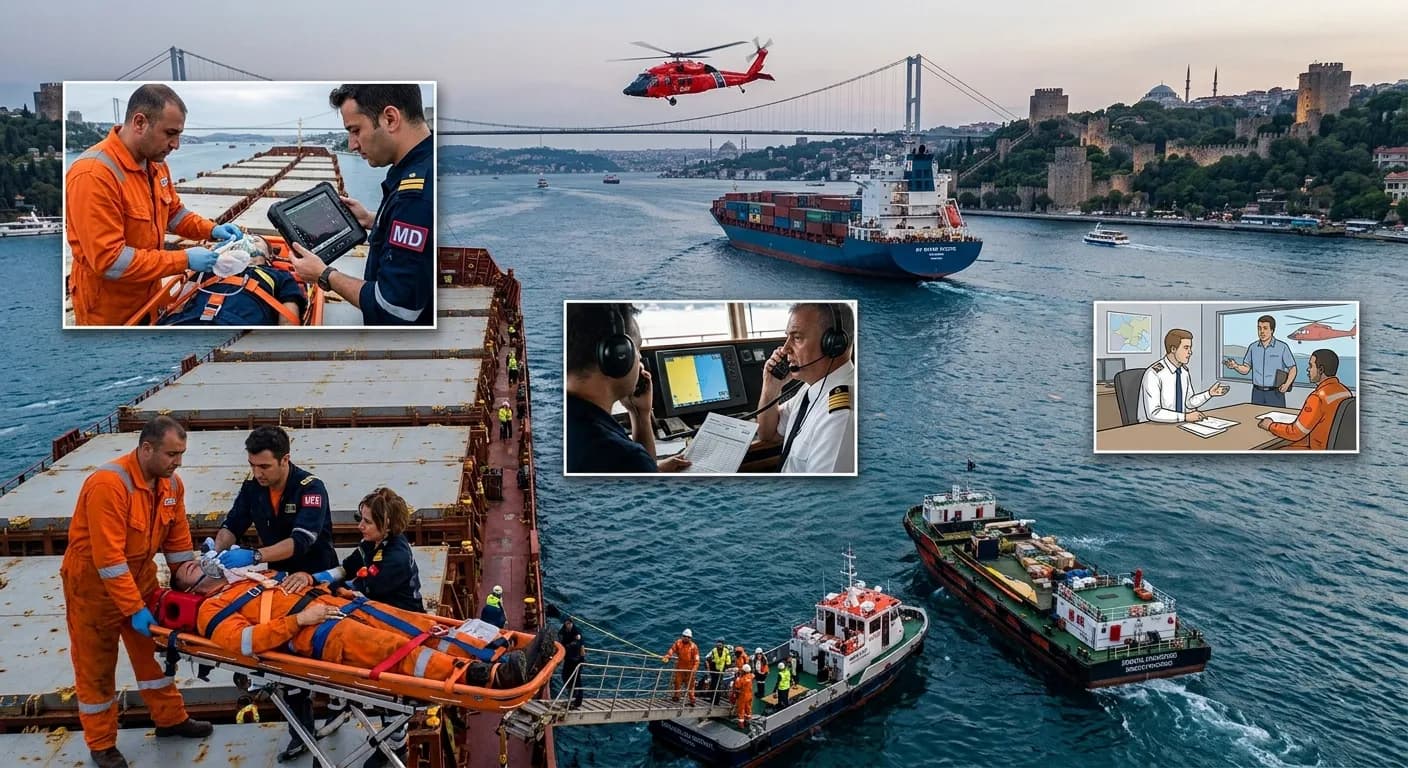
A medical emergency at sea leaves the crew with limited medical support and no immediate access to a hospital. The response depends on the arrangements made before the vessel sails: trained officers, a stocked medicine chest, access to telemedical advice, and a clear plan for diversion or evacuation.
For fleet managers, designated persons ashore (DPAs), crewing managers, and masters, these arrangements need to work together. This guide covers the process from the first report on board to the handover ashore, including medical equipment, telemedical assistance, evacuation procedures, and port health requirements.
The article covers operational preparation, not clinical advice. Onboard treatment must follow the ship's medical guide and the instructions of shore-based doctors.
Operator Obligations Under MLC 2006 and STCW
The Maritime Labour Convention, 2006 (MLC) sets the baseline for medical care on board and ashore. Under Regulation 4.1, flag states must protect seafarers' health and ensure prompt access to medical care. In principle, this care is provided free of charge to the seafarer. The competent authority also adopts a standard medical report form for masters and medical personnel.
Medical personnel and training
Standard A4.1 requires a qualified doctor on ships carrying 100 or more persons on international voyages lasting more than three days. Most cargo ships fall below this threshold. They must carry at least one seafarer responsible for medical care or competent in medical first aid. That seafarer must have the training required under the Standards of Training, Certification and Watchkeeping for Seafarers (STCW).
STCW Regulation VI/4 sets the training requirements for medical first aid and for officers in charge of medical care.
Operators should check that:
- Each vessel has crew members with valid medical training certificates.
- Refresher courses are scheduled before certificates expire.
- The designated medical officer is identified in the vessel's safety management system (SMS).
These checks should be part of routine crewing and compliance procedures, not left until a medical emergency occurs.
Medical Stores and Equipment on Board
The medicine chest must match the vessel type, crew size, and trading area. Flag-state rules set the minimum contents. EU-flagged ships follow Council Directive 92/29/EEC, which defines three categories of medical stores according to the ship's distance from port. Category A applies to seagoing ships with no limit on their distance from port.
Most operators also carry an automated external defibrillator (AED), medical oxygen, and a rescue stretcher suitable for narrow companionways and helicopter transfers.
Stock control and maintenance
The main challenge is keeping the equipment ready for use. Medicines expire, controlled drugs require a register, and items used during an incident must be replaced. Many flag states also require periodic inspections of the medicine chest.
When selecting a supplier of ship medical supplies, operators should check the following:
- Flag-state compliance: The supplier can stock the medical chest according to the applicable list for each vessel.
- Port coverage: The supplier can deliver at the ports used by the fleet.
- Controlled drugs: The supplier provides the required documentation.
- Expiry tracking: The supplier monitors expiry dates and can arrange replacements before items lapse.
- Equipment servicing: The supplier can service AEDs and exchange medical oxygen cylinders where required.
- Delivery records: Orders come with packing lists, expiry information, and other relevant documentation.
Combining medical stores, oxygen cylinder exchanges, and equipment servicing can reduce the number of deliveries required during a port call.
Each item on board should also have a named person responsible for it and a maintenance schedule. This makes it easier to identify missing items, arrange inspections, and prepare replacement orders.
Medical chest certificate and annual inspection
Medicines supplied to a vessel should be accompanied by a medical chest certificate or equivalent inspection documentation, as required by the vessel's flag state. The document confirms that the medicine chest has been inspected and that its contents meet the applicable requirements for the vessel's operation.
Although the exact requirements depend on the flag state, the certificate or inspection documentation should generally identify:
- The vessel's name and, where required, its IMO number and flag.
- The certificate or document reference number.
- The date of inspection and issue date, along with the expiry date where applicable.
- The medical stores scale or inventory used for the inspection.
- Confirmation that the required medicines, medical supplies, and equipment are present and in satisfactory condition.
- Confirmation that medicines meet the applicable expiry-date requirements.
- The name, title, signature, and stamp of the person or organisation conducting the inspection.
For example, the Republic of the Marshall Islands' medical care guidance specifies vessel identification, a unique document reference, issue and expiry dates, and the inspector's name, title, signature, and stamp.
The medicine chest and medical equipment must be inspected at the intervals required by the applicable rules. Inspections are commonly required at least once every 12 months. The MLC 2006 requires regular inspection, while national rules establish the detailed requirements.
An annual inspection does not remove the need for regular stock checks. The crew must monitor individual medicine expiry dates, storage conditions, and quantities throughout the year. Items that have expired, been used, or become unsuitable must be replaced as necessary.
When a supplier replenishes a substantial part of the medical chest, it may be possible to obtain an updated certificate covering the entire chest rather than documentation for individual replacement items.
However, replacing most of the medicines does not automatically make the existing certificate invalid or entitle the supplier to issue a new one. The supplier or inspecting organisation must check the full inventory against the applicable requirements and be qualified or authorised to provide the required certification.
The master should ensure that the updated documentation covers the vessel's complete medical chest and is accepted under the relevant flag-state rules.
When arranging a major restocking, operators should ask the supplier in advance whether it can inspect the complete medical chest and issue updated documentation. This can simplify recordkeeping, provided the full inventory is checked, and the resulting certificate meets the flag state's requirements.
Diana, maritime expert at Records Marine
Reference Guides Carried on Board
The International Medical Guide for Ships (IMGS), published jointly by the International Labour Organization (ILO), the International Maritime Organization (IMO), and the World Health Organization (WHO), is the main clinical reference for ships without a doctor.
The MLC does not require every ship to carry one specific guide. However, national guides should reflect the latest edition of the IMGS.
Ships carrying dangerous goods also need the IMO Medical First Aid Guide (MFAG). Published as a supplement to the International Maritime Dangerous Goods (IMDG) Code, it covers medical responses to exposure to chemicals carried as cargo.
Keep current editions next to the medicine chest or in the ship's hospital. Officers responsible for medical care should know where to find the relevant instructions. Replace outdated editions when the flag state or publisher issues an update.
Radio Medical Advice and Telemedical Support
Medical assistance at sea is part of the wider search and rescue framework. IMO guidance in MSC/Circ.960 describes the role of a telemedical assistance service (TMAS).
A TMAS provides medical advice to the ship, helps assess whether evacuation or diversion may be necessary, and liaises with rescue coordination centres.
Choosing a telemedical service
National services operate in many countries. CIRM in Italy is one example of a recognised national TMAS. Some operators also contract private maritime telemedicine providers. These services can offer a fixed point of contact, follow-up after the initial call, and case records for the company.
The operator should decide which service each vessel contacts first and include that decision in the shipboard procedures. The procedures should list:
- Primary TMAS contact details.
- Satellite phone and email channels.
- A backup service if the primary provider cannot be reached.
Officers also need to know what information to prepare before contacting the service. This includes the vessel's position and estimated time of arrival (ETA) at the nearest port, the patient's age and symptoms, vital signs, and any medicines already given.
When comparing providers, check language coverage, 24-hour availability, and whether the service can help arrange medical care ashore. Confirm that the provider's case records align with the flag state's medical report form.
The Onboard Response Sequence
The response procedure should be included in onboard training and drills. Post it near the ship's hospital so the crew can refer to it during an incident.
The basic sequence is:
- Raise the alarm. Inform the master and bring the medical officer and medical kit to the patient.
- Provide first aid. Work within the officer's training and follow the ship's medical guide.
- Contact the TMAS early. Seek medical advice before the condition worsens.
- Inform the company. Notify the emergency response team so shore arrangements can begin.
- Record the case. Document vital signs, times, and every medicine given on the flag-state medical report form.
- Follow the advice. Continue to follow TMAS instructions and report changes at the agreed intervals.
- Agree on the next step. Consult the TMAS and the company about continuing the voyage, diverting, or requesting evacuation.
The master retains command of the vessel. The TMAS provides medical advice, while the master makes decisions about diversion or evacuation.
Diversion and Medical Evacuation
When the TMAS recommends a medical evacuation at sea, the master contacts the maritime rescue coordination centre (MRCC) responsible for the area. The MRCC coordinates the transfer by helicopter or vessel.
For international cases, the TMAS passes medical information to the service linked to the responsible MRCC.
Preparing the vessel for transfer
For a helicopter evacuation, the crew must prepare the winch area and secure loose items on deck. The patient's documents and medical records must travel with them. These include the passport, seaman's book, and completed medical report form.
The master and crew should follow the instructions provided by the MRCC and the rescue team throughout the transfer.
Crew manning after a helicopter evacuation
After a helicopter evacuation, the master and company should assess whether the remaining crew can continue the voyage safely and meet the vessel's Minimum Safe Manning Document requirements. They should check whether another crew member holds the certificates and qualifications needed to take over the evacuated seafarer's duties. A lower-ranking crew member cannot automatically replace someone in a higher-ranking position.
If the vessel no longer meets minimum safe manning requirements and no qualified replacement is available, the company should contact the flag-state administration for instructions. The vessel may need formal authorisation to proceed to the next port. The master should not assume the vessel can continue the voyage without confirming that the manning arrangements comply with applicable requirements and allow the vessel to operate safely.
Arranging shore support
A diversion also requires coordination ashore. The company should appoint a port agent to arrange hospital admission and transport. The company must also notify the P&I club and check the charter party terms relating to deviation.
Before the vessel arrives, the agent should confirm the applicable port health and immigration requirements. These may affect where the vessel can berth or anchor and how the patient can be transferred to shore.
Country-Specific Port Health Requirements
A medical evacuation or diversion can change the vessel's health status. Port authorities need to receive the required information before arrival. Masters arriving from a foreign port complete a Maritime Declaration of Health. The port health authority then grants free pratique or requires an inspection before clearance.
The reporting channel, form, and deadline depend on the country and port. Operators should confirm these requirements with the local agent before the vessel arrives.
United States
In the United States, the master must report any death or ill person on board to the CDC quarantine station at or nearest the port of arrival. The report covers the 15 days before arrival or the period since the vessel left a U.S. port, if that period is shorter.
Cargo ships use the CDC Maritime Conveyance Illness or Death Investigation Form.
Australia
In Australia, seafarer health reporting falls under the Biosecurity Act 2015. Vessels must submit a pre-arrival report through the Maritime Arrivals Reporting System (MARS) between 96 and 12 hours before arrival.
Masters must report travellers who died or developed a new illness during the previous 21 days. If a person's health status changes after the report has been submitted, the master must notify the National Maritime Centre as soon as practicable.
A crew member who is landed for medical treatment must also be reported as a disembarkation.
United Kingdom
Requirements vary by port. In Plymouth, the Maritime Declaration of Health must be sent by email between 12 and 4 hours before arrival. The agent should confirm the current submission procedure and deadline for the intended port of call.
Special Cases in Evacuation and Port Entry
Some ports have additional procedures for medical evacuations or changes in a vessel's health status. These can affect the transfer itself, not just the paperwork.
Singapore
Within Singapore's search and rescue region, the vessel owner, agent, or master can request a medical evacuation through MRCC Singapore. The transfer can take place by fast craft or helicopter. The vessel should prepare for the operation once MRCC Singapore confirms the evacuation.
Singapore also requires the Immigration and Checkpoints Authority (ICA) to be notified when a crew member is evacuated ashore for medical treatment.
Hong Kong
In Hong Kong, advance free pratique becomes invalid if the health status of anyone on board changes. The vessel must then proceed to the quarantine anchorage for port health clearance.
Germany
In Germany, a positive answer to any health question on the declaration results in a port health examination on arrival.
Panama
Panama checks onboard medical preparation as well as reporting. Flag-state and port-state control officers in Panamanian waters inspect medicine chests, medical equipment, and reference guides. They also check that the personnel responsible for medical care have the training required under STCW Regulation VI/4.
Keeping port health procedures up to date
Operators should maintain a port health matrix for each trading area. For every port, record the reporting channel, deadline, and required form. Ask the port agent to confirm the current maritime medical reporting requirements before a diversion or arrival following an evacuation.
Shore Handover and Follow-Up
When a patient is transferred to a shore hospital, the completed medical report form should accompany them. Keep a copy on board for the vessel's records. MLC Regulation 4.2 sets out the shipowner's liability for sickness and injury, including the cost of medical care ashore and wages for a specified period. The P&I club usually handles the related claims. The crewing department arranges repatriation and a replacement crew member where necessary.
Reviewing the incident
After each case, review the response and identify any gaps. Check how quickly the crew contacted the TMAS, whether the communication and escalation procedures worked, and whether the medical stores and equipment were in suitable condition.
Restock the medicine chest at the next port. Update the shipboard procedures if any step failed or caused a delay. Keep medical records confidential, in line with the MLC requirements.
Find Medical Stores and Maritime Services on Records Marine
Preparing for a medical emergency requires coordination between the vessel, the telemedical provider, medical supply vendors, the port agent, and the crewing team. Records Marine lists suppliers of medical stores, telemedicine providers, port agents, and crew management services. Plan ahead by finding reliable suppliers and arranging medical supplies and emergency support before the next voyage.