Planning a Ship Repair in Oman: Import Costs, Lead Times and Seasonal Limits

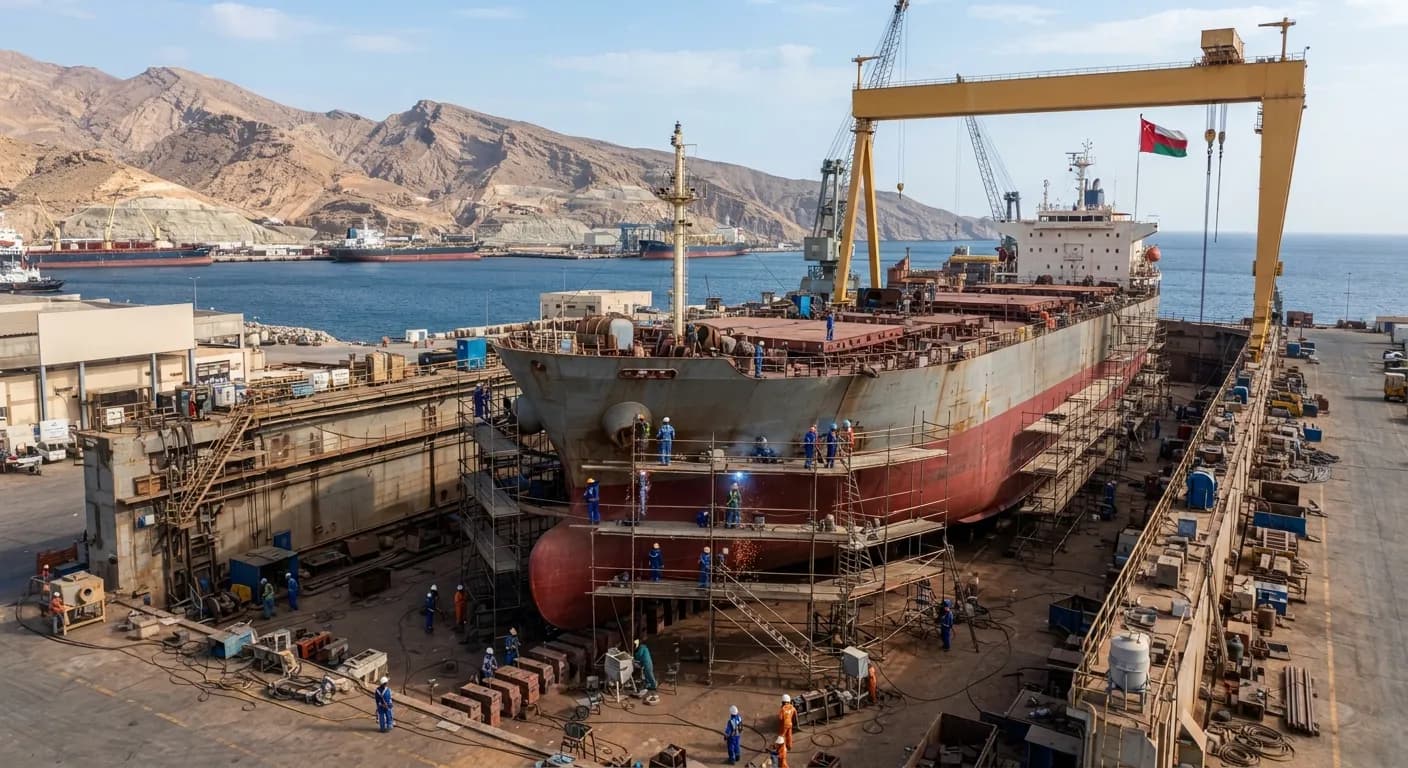
Planning a ship repair in Oman takes more preparation than a similar job in the UAE. Many spare parts, consumables and coatings still need to be transported by road from the UAE, while import charges, summer working restrictions and new vessel licensing rules can add time and cost to the project.
For technical superintendents and purchasing teams, it is important to know what to order early, what to keep on board and what additional costs to expect at the border. These considerations are particularly important when arranging repairs in Duqm, Salalah or Sohar.
Demand for repair capacity in Oman increased in 2026. This makes early planning even more important: book the yard slot and arrange the supply chain sooner than you might have in previous years.
What Can You Source Locally in Oman?
Local supply options remain limited outside the main shipyard. Buyers who expect to find the same range of ready-stock items available in the UAE may lose valuable time waiting for parts to arrive.
Outside the yard, buyers depend largely on traders and agents. Many maintain limited inventories and order products from the UAE only when a customer requests them.
Take marine paint, for example. Jotun and Hempel both manufacture paint in Oman, but most of the country's paint market serves the decorative segment. Local production therefore does not guarantee that a particular marine coating system is available when you need it.
Before relying on local supply, confirm that the specified product is physically in stock and can be delivered within your repair schedule.
Local suppliers can usually cover provisions and a handful of minor consumables; the rest comes across the border.
Suppliers in Oman often source the goods from the UAE and add transport costs and their own margin. In many cases it is cheaper to contact UAE suppliers directly — they can deliver straight to the shipyard in Oman.
— Diana, maritime expert at RecordsMarine
This is particularly relevant when ordering routine consumables and other supplies that may appear easy to source locally but are not necessarily held in stock.
Importing from the UAE: Customs Duty, VAT and Who Pays
A common planning assumption is that importing spare parts into Oman adds around 10% to the cost. The figure is broadly consistent with the applicable charges on many shipments, but it represents two separate costs: customs duty and import VAT. Oman generally applies the GCC (Gulf Cooperation Council) common customs duty of 5% of the cost, insurance and freight (CIF) value to goods originating outside the GCC. Import VAT adds another 5% on taxable goods.
The important detail is where the goods originate and how they enter the GCC customs territory. Goods of GCC origin can move between GCC states without customs duty. However, goods stored in a UAE free zone, such as Jebel Ali, remain outside the GCC customs territory. When they first enter the GCC mainland, they can trigger the 5% customs duty. This matters because many original equipment manufacturer (OEM) spare parts stocked in UAE free zones fall into this category.
This is why you should always check the country of origin shown on the invoice rather than assuming that goods shipped from the UAE qualify as GCC-origin products.
The following table summarises the three common scenarios.
Swipe horizontally to view all columns
Shipment from the UAE | Customs duty | Import VAT |
|---|---|---|
Non-GCC-origin goods shipped from a UAE free zone | 5% of CIF value | 5% |
Non-GCC-origin goods already cleared through customs in the UAE | Not charged again under the single-entry rule; confirm with the broker | 5% |
GCC-origin goods accompanied by a commercial invoice | 0% | 5% |
Consider a shipment of spare parts with a CIF value of USD 10,000. If the goods are of non-GCC origin and customs duty applies, the duty is USD 500. VAT on the value plus duty adds another USD 525. The combined charges amount to USD 1,025, or approximately 10.25% of the customs value.
There is one more detail to consider. Austria's trade agency has noted that customs duty may sometimes be charged in practice even on goods moving between GCC states. This is why you should ask the customs broker for a pre-clearance estimate rather than relying entirely on the expected rate.
Who pays the charges?
The importer of record is responsible for paying the charges at the border. A foreign shipowner generally needs a locally based importer, which is usually the agent, shipyard or supplier. The cost then appears on that party's invoice.
VAT-registered businesses in Oman may be able to reclaim import VAT. Oman's VAT law also applies a zero rate to certain supplies linked to international transport. Ask the agent how VAT will be treated on the shipyard invoice so that the cost is clear before the work begins.
Three additional factors can affect the import budget.
1. Free zones
Duqm, Sohar and Salalah are designated zones. Goods imported for use within a zone are generally exempt from customs duty, while goods that leave the zone for the mainland are subject to standard duty. Ask whether the shipyard can receive your spare parts under the applicable zone rules.
2. Temporary imports of tools
Oman has not signed the ATA Carnet Convention. Service engineers bringing tools and testing equipment into the country therefore need to declare them as temporary imports. Customs holds a deposit equal to 5% of the equipment's value and refunds it after the goods are re-exported.
3. Road transport availability
Road freight capacity in the region tightened in 2026. Cargo diverted from Jebel Ali now enters through Oman and Fujairah before continuing overland, keeping trucks occupied for longer. This can affect delivery schedules even when the parts are available at the supplier.
Road transport from the UAE to Oman typically takes one to two days, provided the roads are not congested and customs clearance at the border proceeds without delays.
Traffic congestion and border delays are common, so do not leave transport arrangements until the last minute. If an order is urgent, send it on a dedicated truck rather than waiting for other orders to be consolidated. The cost of a truck is negligible compared with the cost of a vessel sitting idle in the shipyard for an extra day.
— Diana
For purchasing teams, this means that transport should be arranged as soon as the supplier confirms readiness. Consolidating shipments may reduce freight costs, but it can be a false economy if a critical item arrives too late and delays the repair schedule.
Paint and Other Long-Lead Items
For hull and tank coatings, allow at least two to three weeks in Oman. This estimate comes from project experience rather than a published standard, so treat it as a planning guideline rather than a guaranteed delivery time. The safest approach is to order the paint once the drydock date is confirmed, not when the vessel is already sailing towards Oman.
Local manufacturing helps, but it does not eliminate the need for advance planning. Jotun operates a factory in Rusayl Industrial Estate, while Hempel produces paint in Sohar Industrial Estate. Even so, the exact marine coating system may not be available from local stock. Antifouling products, tank linings and specific colours may require a new production batch or transfer from the UAE. Confirm availability against the actual specification before including the delivery date in the repair schedule.
The two-to-three-week lead time reflects more than manufacturing and transport. Purchasing teams must also allow time to collect quotations, compare prices, complete the company's internal tender process and confirm the quantity required.
Once paint has been imported into Oman, the supplier cannot take unused stock back across the border. Calculate the quantity carefully and order a small reserve — discovering halfway through hull coating that you are short costs far more than the extra paint.
— Diana
Most suppliers manufacture or source hull coatings in the UAE before transporting them to Oman. UAE paint manufacturers and distributors serve multiple customers, so the full quantity may not be available from stock when an order is placed. Production may also be delayed while the supplier fulfils other orders. Documentation and road transport to the shipyard add further time.
These factors explain why two to three weeks is a reasonable planning estimate, although actual delivery times depend on the product specification, quantity and supplier workload. Start the quotation and ordering process as soon as the drydock date becomes known.
Fuel is another item that requires attention. In March 2026, bunker supplies, including low-sulphur marine gas oil (LSMGO), were reported to be tight and intermittent at Muscat, Duqm and Sohar.
The same principle applies to other long-lead repair supplies. Lead times depend on the equipment manufacturers, the availability of OEM parts and whether the owner is willing to accept compatible alternatives or requires original parts.
OEM Engineers, Class Surveyors and Workshops
Duqm is Oman's main ship repair hub, with the country's principal repair yard and a broad range of technical services. At Sohar and Salalah, operators should expect to rely more heavily on visiting engineers.
Asyad Drydock operates two graving docks capable of accommodating vessels up to 500,000 and 600,000 deadweight tonnes (DWT).
Investment in Duqm is attracting more suppliers and OEM facilities to the port. However, increased capacity does not mean that a suitable repair slot will always be available when needed. Confirm the drydock or berth slot and the planned sequence of work in writing before committing the vessel.
OEM service engineers will usually need to travel from the UAE or farther afield. The schedule should account for visas, temporary import procedures for tools and travel time. Arrange class attendance early as well, and confirm whether the required surveyor is based in Oman or needs to travel there.
Heat, Khareef and Ramadan: Three Seasonal Constraints
Repair schedules in Oman need to account for three seasonal factors: summer heat restrictions, the southwest monsoon known as Khareef, and Ramadan working hours. Each affects the number of productive hours available, but the impact varies by location and type of work.
Swipe horizontally to view all columns
Period | Where | Rule or condition | Effect on repair work |
|---|---|---|---|
1 June – 31 August, daily 12:30–15:30 | All Oman | Midday restrictions prohibit outdoor and exposed work. Fines range from OMR 500 to OMR 1,000. | Deck, hull and blasting work stops for three hours. Port operations may continue only with prior approval and heat controls. |
June – September | Salalah and Duqm | The southwest monsoon, or Khareef, affects operations. Salalah anchorage closes for the season. | Launch services and afloat work at anchor may be restricted if waves are too high. |
Ramadan | All Oman | In 2026, Muslim private-sector employees worked a maximum of six hours per day and 30 hours per week. | Shorter shifts mean additional time may be needed for approvals and customs clearance. Eid al-Fitr holidays follow Ramadan. |
New Rules for Foreign Vessels and Port Security
Shipowners planning repairs in Oman also need to check the licensing requirements for foreign vessels. Ministerial Decision No. 30/2026 introduced a new licensing regime for foreign vessels operating in Omani territorial waters. It entered into force in early February 2026. The decision exempts vessels that call at Omani ports only to load or discharge cargo. Repair calls and waiting at anchor are not listed among the exemptions.
This distinction matters when arranging a repair stop. A vessel that enters Omani waters for work should not assume that it qualifies for the same exemption as a vessel making a routine cargo call.
The shipping agent must submit the licence application at least three days before the vessel enters. The application requires registration details, proof of P&I cover and information about the intended activity. The authority then has three days to make a decision, and fines range from OMR 500 to OMR 5,000.
Before fixing the repair dates, ask the agent whether the call requires a licence. If it does, allow up to six days for the application and decision process.
Check port status and war-risk cover
Licensing is not the only issue to consider. Port operations also faced security-related disruption in 2026. Drone strikes in March caused temporary suspensions at Duqm and Salalah, including at Asyad Drydock in Duqm. Salalah resumed operations within days after a later strike.
Before confirming a repair schedule, check the current status of the port and make sure the vessel's war-risk cover is appropriate for the planned call. Conditions can change, and a confirmed repair slot does not eliminate the risk of operational disruption.
How to Plan: Order, Carry, or Buy Locally
Diana's rule for purchasing teams is simple:
Once the repair list is ready and the required supplies identified, start purchasing and delivery immediately. The aim is to have as much material as possible in Oman before the vessel arrives — especially anything that must be replaced during dry docking.
— Diana
Once the repair scope is established, divide the requisition into three groups. This separates items that need long lead times from those that can be sourced locally after arrival.
1. Four weeks or more before arrival: order
Start with the items and arrangements that can hold up the entire project.
- Confirm the shipyard slot and repair work list.
- Order coatings, OEM spare parts and any other items requiring production lead time.
- Appoint the shipping agent and importer of record.
- Request a customs duty and VAT estimate for each shipment.
- Book OEM engineers and class surveyor attendance.
- Ask the agent whether a licence to enter Omani territorial waters is required.
The aim is to identify potential delays while there is still time to resolve them.
2. Before departure: carry critical items on board
Load critical spare parts, gaskets, filters and the small consumables that the crew uses daily. Having these items on board avoids the need for a separate import and an additional road transport leg. It also reduces dependence on local stock and delivery schedules.
3. On arrival: buy locally
Use the yard or local suppliers for labour, scaffolding, crane hire and general consumables. Keep a second source in the UAE for any items that may run short. This provides another sourcing option if the local supplier cannot meet the required quantity or delivery date.
Whichever approach you use, allow additional buffer time for repairs scheduled during June–August, during Khareef at Salalah, or during Ramadan.
Finding Ship Repair Suppliers in Oman
Planning a repair call in Oman starts with identifying suitable suppliers both inside the country and across the border in the UAE.
RecordsMarine lets shipping companies compare ship repair yards in Oman, service companies and marine paint suppliers in Oman and the UAE. Sending enquiries to several relevant suppliers gives technical superintendents and purchasing teams an opportunity to compare lead times and import terms before the vessel sails.
The earlier these arrangements are made, the easier it is to coordinate deliveries, account for customs charges and build a realistic repair schedule around the yard's availability and local operating conditions.