Suez Canal Transit: Equipment Checks and Technical Condition Requirements

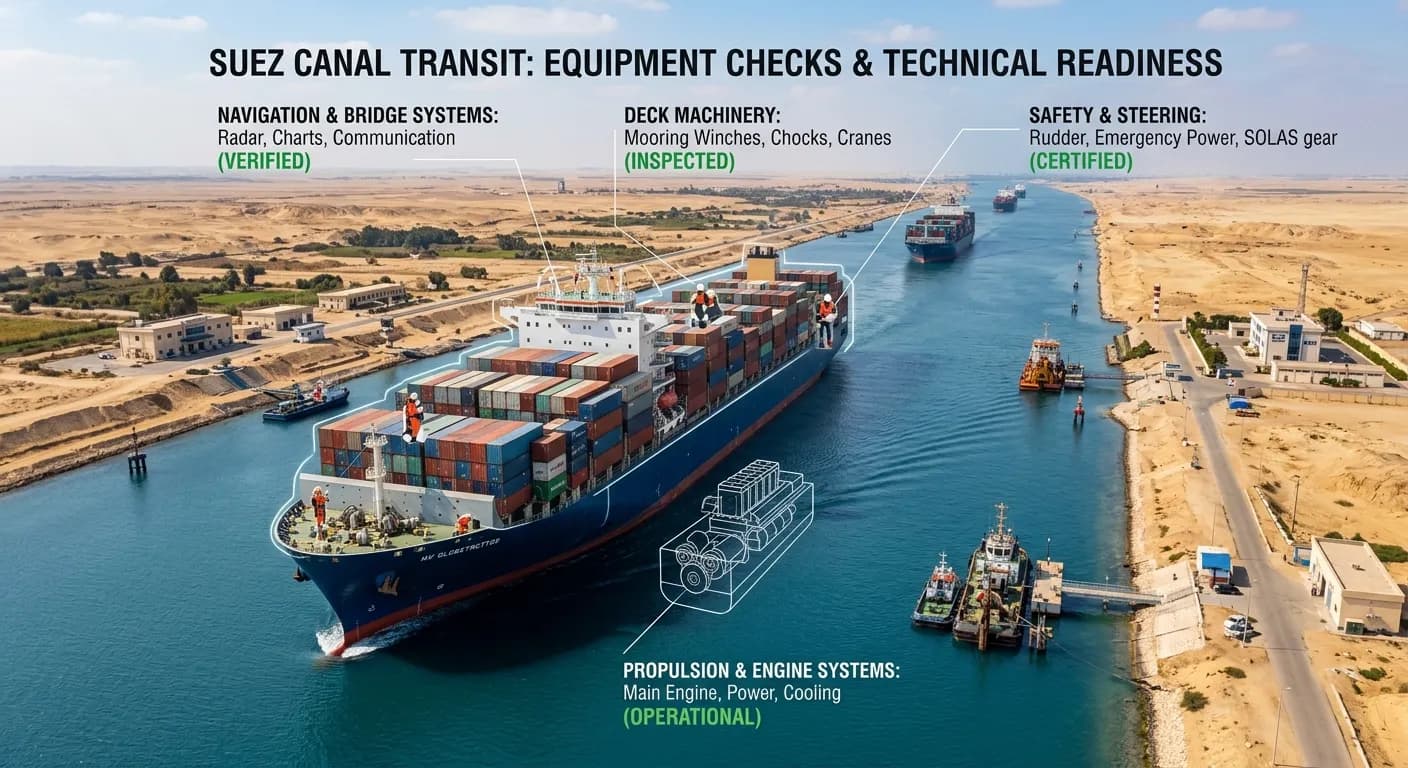
A smooth Suez Canal transit depends on three things: the ship must be technically ready, the required documents must be complete, and the ship must arrive on time. If any of these conditions is not met, the ship may have to pay extra dues, take an imposed tug, or wait for the next convoy.
There are also three changes that ship operators need to know about in 2026:
- Every ship must carry its own compliant searchlight. The SCA no longer rents one.
- Mooring is handled from shore stations. No mooring crew boards the ship.
- A missing or non-compliant searchlight costs USD 500 per transit.
These requirements affect the preparation for the entire transit, from the documents sent to the agent before arrival to the equipment checked by the crew before entering the canal.
Ships cross the canal in convoys. One convoy runs southbound from Port Said, while another runs northbound from Suez (Port Tewfik). To join the planned convoy, each ship must reach its waiting area before the applicable cut-off time, known as the limit time.
The process starts before the ship reaches the canal. The agent books the transit and submits the required documents to the SCA. Once the ship arrives, the master reports any known defects. The pilot then boards, and the master signs the Declaration of Navigability. After that, the ship joins the convoy and follows the applicable speed limits. The pilot leaves at the exit buoys.
In practical terms, the transit follows these six steps:
- The agent books the transit and files the ship's documents with SCA.
- The ship arrives at Port Said or Suez before the limit time.
- The master reports any known defect to SCA.
- The pilot boards and hands the master a Declaration of Navigability to sign.
- The ship joins the convoy and follows the speed limits.
- The pilot leaves at the exit buoys.
Although the pilot advises the bridge team during the transit, the master remains responsible for safe navigation.
The ship must also follow several operating restrictions while it is in the canal. Hand steering is required, and autopilot is forbidden. Anchoring and thrusters are not allowed except in a real emergency. The ship must maintain a bridge watch, engine room watch, and anchor watch. The speed limit is 16 km/h for ordinary ships and 14 km/h for tankers.
Arriving late
Because ships travel in convoys, arrival time is an important part of the planning. Circular 5/2015 sets the limit time at 2300 local time for both directions. A ship that arrives after this time may still be allowed to join the convoy, but the delay results in a surcharge on its transit dues. The later the ship arrives, the higher the surcharge, subject to the applicable maximum:
Swipe horizontally to view all columns
Arrival time (local) | Surcharge on transit dues | Maximum |
Before 23:00 | None | — |
23:00–00:00 | 5% | SDR 12,500 |
00:00–01:00 | 10% | SDR 25,000 |
After 01:00 | 12%, only if traffic permits | SDR 30,000 |
The limit time is not something to assume from an old voyage plan. SCA changes convoy times often, so the agent should always confirm the current limit time before arrival.
Getting the Documents Ready
Timing is only one part of the preparation. The ship also needs to have the correct documents ready before arrival. Article 15 of the Rules of Navigation lists the documents required for the transit, and these should be sent to the agent in advance.
The required documents include:
Swipe horizontally to view all columns
Document | Who needs it | Note |
Suez Canal Special Tonnage Certificate + calculation sheets | All ships | 3 copies on the first transit. Without it, SCA charges dues on a temporary tonnage. |
Certificate of Registry | All ships | — |
Ship's drawing | All ships | — |
Last Classification Certificate | All ships | — |
Declaration of State of Navigability | All ships | — |
Statistical Declaration | All ships | — |
Declaration on double-bottom and high tanks | All ships | — |
Declaration for ships in ballast | Ships in ballast | — |
Cargo information (containers, barges, etc.) | All ships | Wrong cargo data doubles the dues difference. |
IOPP Certificate + supplement | Tankers | — |
Piping plan + general arrangement plan | LPG and LNG carriers | — |
The SCA can also ask for a new seaworthiness certificate. Under Article 15(D), it may request one from an IACS class society. If the certificate is in another language, it must be translated into Arabic or English and certified by the consulate in Egypt.
Getting the paperwork ready early matters because a documentation problem can affect the transit just as much as a technical problem.
Equipment That Must Work
The next step is to make sure the ship itself is ready for the canal. The equipment listed below must be in good working order before transit.
Swipe horizontally to view all columns
Group | Equipment |
Steering | Steering gear, rudder angle indicator |
Propulsion | Engine room machinery, main engine RPM indicator, telegraph |
Communication | VHF, bridge–engine room communication |
Navigation | Radar, whistle |
Deck | Both anchors, mooring lines (at least 6 floating lines), fire wires fore and aft |
Lighting | Bow searchlight to SCA specification |
If the ship does not have a telegraph logger, the crew must keep bridge and engine room movement books during the transit.
These checks are important because some defects can prevent the ship from entering the canal or require it to transit under an SCA tug.
When SCA Can Refuse the Transit
SCA does not allow a ship to enter in certain conditions. For example:
- The rudder angle indicator is defective. The ship may transit only under SCA tow.
- The list is more than 3°.
- The tropical load line is submerged or the load lines are not visible.
- The ship is trimmed by the bow.
- Trim or stability affects manoeuvrability.
- Draught exceeds the canal maximum.
- Deck cargo sticks out over the side and endangers the transit.
- Dangerous cargo does not meet the Rules.
This is why known defects should be reported rather than hidden. Since 1 April 2022, a pilot or harbour master who finds a withheld or misreported defect can apply USD 10,000 in extra dues.
What Changed for Searchlight and Mooring in 2026
The equipment requirements became particularly important in 2026 because SCA changed its approach to searchlights and mooring.
SCA Circular 1/2026 took effect on 15 May 2026 and changed several things.
Swipe horizontally to view all columns
Topic | Before 15 May 2026 | From 15 May 2026 |
Mooring service | Shore-based, but about 30% of ships took mooring boats on board | Shore-based for all ships. No mooring crew on board |
Mooring fee | — | USD 3,800 above 2,500 GRT. USD 2,350 below 2,500 GRT |
Searchlight | Ship could request a rented projector and electrician | Ship must carry its own compliant searchlight |
Electrician on board | Yes, with rented projector | No |
Penalty for no or non-compliant searchlight | Extra dues for lighting service | USD 500 per transit, from the first transit |
The new rules mean that operators should check the searchlight before the ship arrives rather than relying on a service that was previously available from the canal authority.
There are still some exceptions to the general mooring rule. SCA keeps the right to order onboard mooring for certain units:
- Towed units
- Drilling rigs
- Integrated units
- Units of a special nature or with special arrangements
If such a unit refuses, SCA imposes a tug. The cost is SDR 22,000, or about USD 30,000.
Searchlight requirements
SCA inspects the searchlight on the first transit and inspects it again if the last transit recorded a remark.
The main points of the specification include:
- It must be fitted on the bow and light both canal banks clearly.
- It must have a watertight drum.
- A gastight version is required where class rules require it.
- It must have two lamp carriers, so the light keeps working if one lamp fails.
- It must have permanent electrical connections.
- A type-test certificate is required. The original must be kept on board for SCA officials.
What Can Go Wrong, and What It Can Cost
The requirements above are not just paperwork. A technical failure, incorrect declaration, late arrival, or failure to follow an SCA requirement can result in additional costs or delays.
The largest costs can come from imposed tugs and withheld defects. A missed limit time results in a percentage surcharge on the transit dues.
Swipe horizontally to view all columns
Problem | Consequence |
Rudder angle indicator defective | No transit, or transit under SCA tow |
Engine or steering failure for the 2nd time in one passage | Chargeable SCA tug |
Cannot use one or both anchors (ships over 1,500 SC GT) | Chargeable SCA tug |
Defect withheld or misreported | USD 10,000 |
Special unit refuses onboard mooring | Imposed tug, SDR 22,000 (≈ USD 30,000) |
No searchlight or non-compliant searchlight | USD 500 per transit |
Arrival after limit time | 5–12% of transit dues |
Wrong cargo or ballast declaration | Dues difference is doubled |
Ship trimmed by the bow | No transit until trim is corrected |
SCA can also delay a ship to investigate an incident or rule violation. It does not pay damages for such a delay.
For operators and crew, the lesson is simple: the cost of checking the ship before arrival is much lower than the cost of correcting a problem during the transit.
Final Checklist Before Arrival
The safest approach is to turn the requirements into a pre-arrival check. The following checklist brings together the documents, equipment, stability, and reporting requirements described above.
Papers – superintendent and agent
- Suez Canal Special Tonnage Certificate on board. Three copies of the calculation sheets are required for a first transit.
- Full Article 15 document set sent to the agent.
- Cargo and ballast declarations checked for accuracy.
- Current limit time confirmed with the agent.
Searchlight – chief engineer and electrician
- Own searchlight fitted on the bow.
- Two lamp carriers working.
- Permanent electrical connections in place.
- Original type-test certificate on board.
Bridge and engine room – master and chief engineer
- Steering gear tested. Hand steering ready.
- Rudder angle indicator working.
- Main engine RPM indicator working.
- Telegraph, VHF, radar, whistle, and bridge–engine room communication tested.
- Movement books ready if there is no telegraph logger.
Deck – chief officer
- Both anchors and windlass tested.
- At least 6 floating mooring lines ready.
- Fire wires rigged fore and aft.
Stability – chief officer
- Ship is not trimmed by the bow.
- List is under 3°.
- Draught is within the canal limit.
- Load lines are visible.
On arrival – master
- Report all known defects to SCA.
- Sign the Declaration of Navigability for the pilot.
Plan Suez Canal Services Before Arrival
Technical readiness is only one part of preparing for a Suez Canal transit. If the ship needs equipment, repairs, inspection support, mooring-related services, or other supplies before or after the canal passage, finding the right supplier early can help avoid last-minute delays.
RecordsMarine connects shipowners, managers, operators, and procurement teams with maritime suppliers and service providers. Buyers can search for suppliers by category and port, select the companies they want to contact, and send one RFQ to multiple suppliers. Suppliers can reply with their prices, delivery times, and certificates, making it easier to compare offers and place an order.
Maritime companies can also register on RecordsMarine to increase their visibility among shipowners, managers, operators, and procurement teams looking for suppliers and services. Create a company profile and be ready to respond when a relevant RFQ comes in.